

How to Price Handmade Products for Profit
Every maker who starts selling hits the same wall. You finish a beautiful piece, you're proud of it, and then someone asks the question that makes your stomach drop: "How much do you charge?"
Most of us mumble something, pick a number that feels safe, and immediately wonder if we said too much or too little. Spoiler: it was too little. Almost always too little.
Here's the thing. If you enjoy making something, your brain tricks you into thinking you shouldn't charge much for it. "It was fun!" you tell yourself while ignoring the four hours you spent sanding, the $30 in materials, and the electricity bill from running your laser for half the afternoon.
You're running a business, not a charity. Let's fix your pricing.
The Undercharging Problem
The number one pricing mistake makers commit is pricing based on what they would pay, not what the product is worth. You know exactly how easy it was to make, so it feels wrong to charge a premium. Your customer doesn't know that. They see a beautiful, handcrafted product and they're willing to pay for it.
Then there's the race to the bottom. You hop on Etsy, see someone selling a similar item for $15, and think you need to match that price. That seller is either losing money, working for $3 an hour, or buying mass-produced items from overseas and calling them "handmade." None of those are strategies you should copy.
Undercharging isn't humble. It's unsustainable. You can't buy better materials, upgrade your equipment, or keep making things if every sale barely covers your costs. Eventually you burn out and quit, and the world loses another talented maker.
If you're already selling on Etsy and struggling with pricing pressure, check out our complete guide to selling on Etsy for strategies that go beyond just lowering your prices.
PRINT. CUT. CARVE.
- Multiple formats (SVG, DXF, PNG)
- Machine-tested designs
- Commercial licenses
Sponsored by PrintCutCarve.com
Cost-Based Pricing (The Foundation)
This is where every pricing conversation should start. Before you worry about what the market will bear or how fancy your packaging is, you need to know what it actually costs you to make something.
The formula is straightforward:
Materials + Labor + Overhead + Profit Markup = Wholesale Price
Wholesale Price x 2 = Retail Price
Let's break each piece down.
Materials
This is every physical thing that goes into the finished product and gets it to the customer. The obvious stuff like wood, acrylic, vinyl, and resin. But also the less obvious stuff: finish, sealant, sandpaper, glue, packaging, tissue paper, thank-you cards, labels, and shipping materials.
Keep a spreadsheet. Track what you spend per unit. It doesn't have to be exact to the penny, but "about $5 in materials" isn't good enough when you're trying to run a real business.
Labor
This is the big one. YOUR TIME HAS VALUE.
Pay yourself at least $15 to $25 per hour, depending on your skill level and market. If you've been doing this for years and produce high-quality work, $25 or more is absolutely reasonable.
Track your actual production time for a few pieces. Include design time, setup, production, finishing, photography, listing creation, packaging, and shipping. Most makers dramatically underestimate how long things take once you count everything.
Overhead
These are the costs of running your business that aren't tied to a single product:
- Machine depreciation (a $4,000 laser spread over its useful life)
- Electricity
- Software subscriptions
- Etsy fees (6.5% transaction fee)
- Payment processing (roughly 3% plus a small per-order fee for US sellers; check Etsy's fee page for your country's rate)
- Tools and replacement parts
- Workspace costs (even if it's a corner of your garage, that space has value)
A simple approach: estimate your monthly overhead, divide by the number of products you make per month, and add that per-unit cost.
Profit Markup
This is not your paycheck. You already paid yourself in the labor section. The profit allowance is what funds business growth: new equipment, better materials, marketing, classes, and a buffer for slow months.
Adding a percentage on top of cost is a markup. For example, a 20% markup on $100 of total cost gives a $120 price and a 16.7% margin. A 20% margin on selling price would require $125. Choose your allowance from your actual costs and sales channel; the two percentages are not interchangeable.
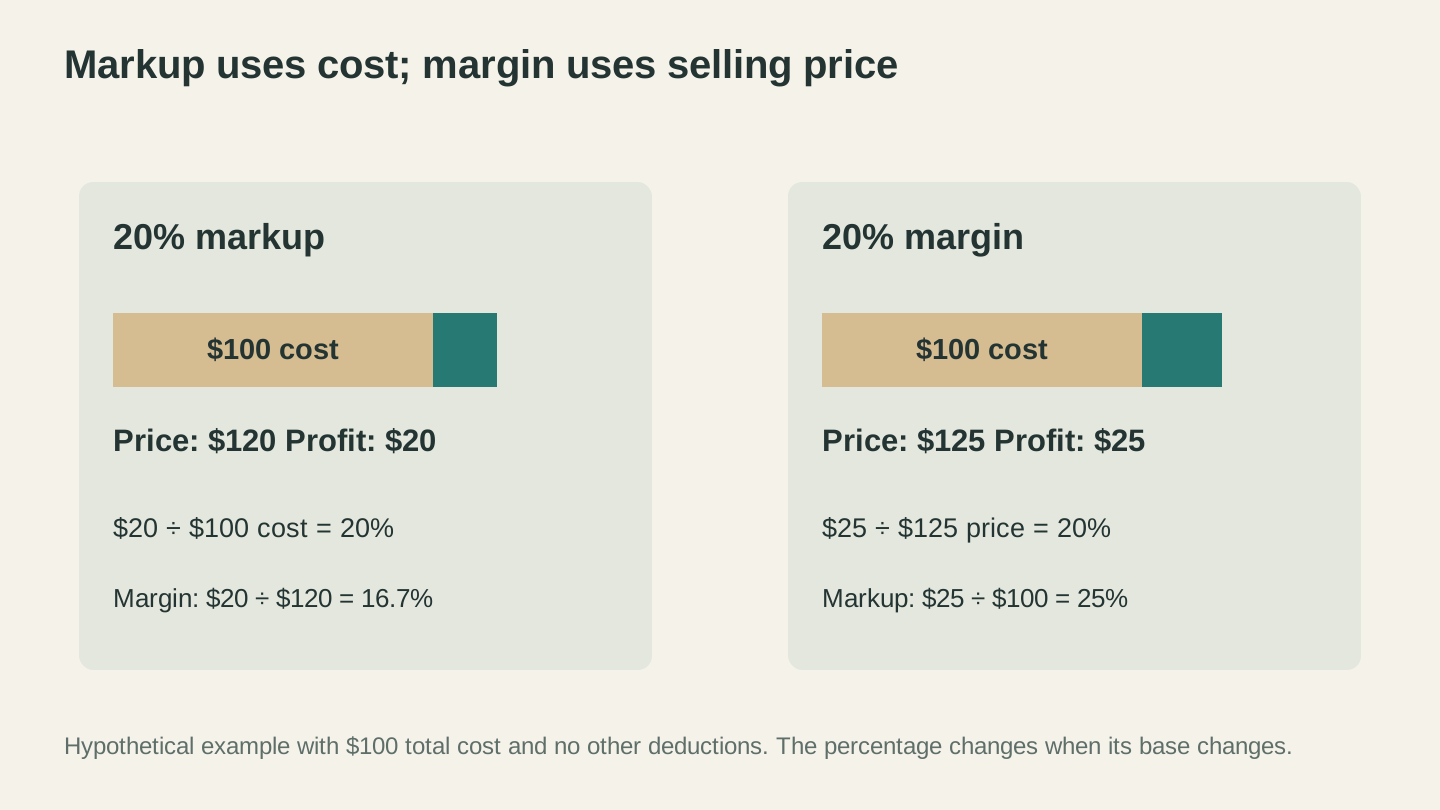
Markup uses cost as its base; margin uses selling price. With a $100 cost, a 20% markup produces a $120 price, while a 20% margin requires $125.
A Real Example: Laser Engraved Cutting Board
Let's run the numbers on a personalized cutting board, one of the most popular laser projects.
| Cost Category | Breakdown | Amount |
|---|---|---|
| Materials | Board ($8) + finish ($1) + packaging ($2) | $11.00 |
| Labor | 30 min design + 15 min engrave + 15 min finish = 1 hr @ $20/hr | $20.00 |
| Overhead | Machine depreciation, power, platform fees | $3.00 |
| Subtotal | $34.00 | |
| Profit markup (20% of subtotal) | $6.80 | |
| Wholesale price | $40.80 | |
| Retail price (2x wholesale) | ~$82 |
"Eighty-two dollars for a cutting board?!" you might be thinking. But go search Etsy for personalized cutting boards and look at the established shops with lots of reviews. You'll find plenty of them in the $50 to $90 range. The ones selling well aren't the cheapest. They're the ones with great photos and compelling descriptions.
Warning
If your cost-based price seems "too high," the answer is not to lower your prices. It's to find higher-value markets or reduce your production time. Selling yourself short is never a business strategy.
Market-Based Pricing (The Reality Check)
Cost-based pricing tells you your floor. Market-based pricing tells you what customers are actually paying right now.
Do your research. Search for products similar to yours on Etsy, Amazon Handmade, and at local craft fairs. But here's the critical detail: look at review counts and how well-established each shop is, not just the lowest price on the page.
The cheapest listings are not the most successful ones. The shops with the most reviews and sales almost always charge more than average. They succeed because they have better photos, better descriptions, better branding, and better customer service.
When you're researching, note the price range for products comparable to yours. If the best sellers are charging $60 to $100 for something similar, and your cost-based price lands at $82, you're right in the sweet spot.
If your cost-based price is significantly above the market, you have two options: find ways to reduce production costs (batch processing, better workflow, cheaper materials without sacrificing quality) or find a different market entirely. Custom and personalized products almost always command a premium over generic ones.
Perceived Value Pricing (The Profit Multiplier)
This is where makers leave the most money on the table. The perceived value of your product has very little to do with what it costs you to make and everything to do with how the customer experiences it.
Personalization
Adding a name, date, or custom message to a product meaningfully increases its perceived value, because it turns a generic item into something made just for the buyer. A generic wooden sign might sell for $35. The same sign with "The Johnson Family, Est. 2019" engraved on it sells for $55. Your extra cost? Maybe two minutes of laser time and a few seconds of typing.
Check out our guide to personalized gifts with a laser engraver for ideas on products that naturally command premium pricing.
Professional Photography
This might be the single highest-ROI activity for your business. Here's an illustration of the effect: a product photographed on a kitchen counter with overhead lighting looks like a $20 item. The same product styled on a marble surface with natural window light and a sprig of eucalyptus looks like a $60 item.
You don't need a professional camera. A recent smartphone and good natural light will get you 90% of the way there. And if you want to take it further, ListingLab can generate AI product photos in dozens of styles, from lifestyle shots to seasonal setups, for 1 credit per image.
Packaging
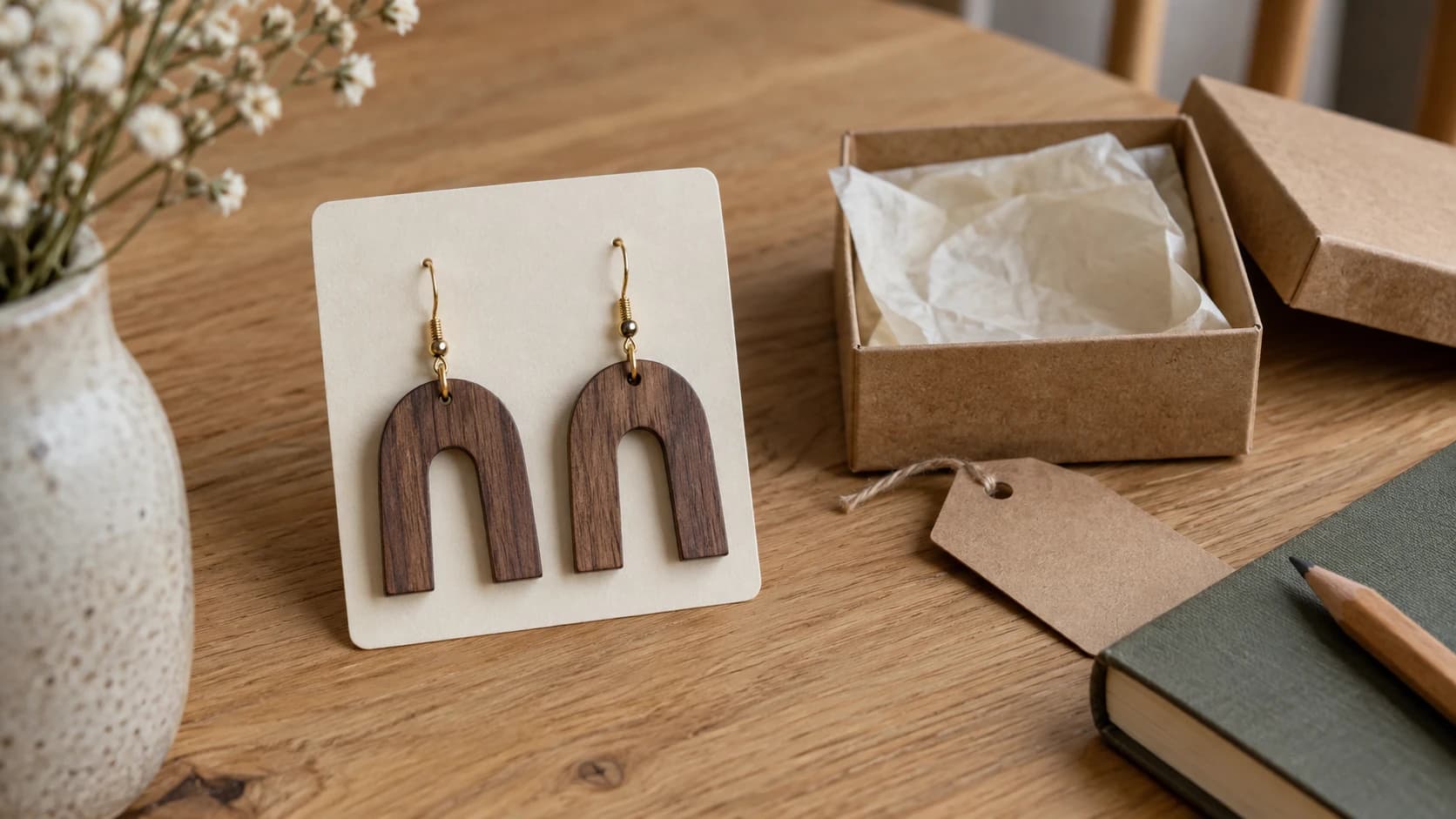
Never underestimate packaging. A $40 product in a plain brown box feels like a $40 product. The same item nestled in a kraft gift box with tissue paper, a hand-stamped thank-you card, and a small ribbon feels like a $60 gift. As a rough illustration, your packaging cost difference might be $2 to $3, while the perceived value increase could be $15 to $20 or more, the exact numbers will depend on your product and audience.
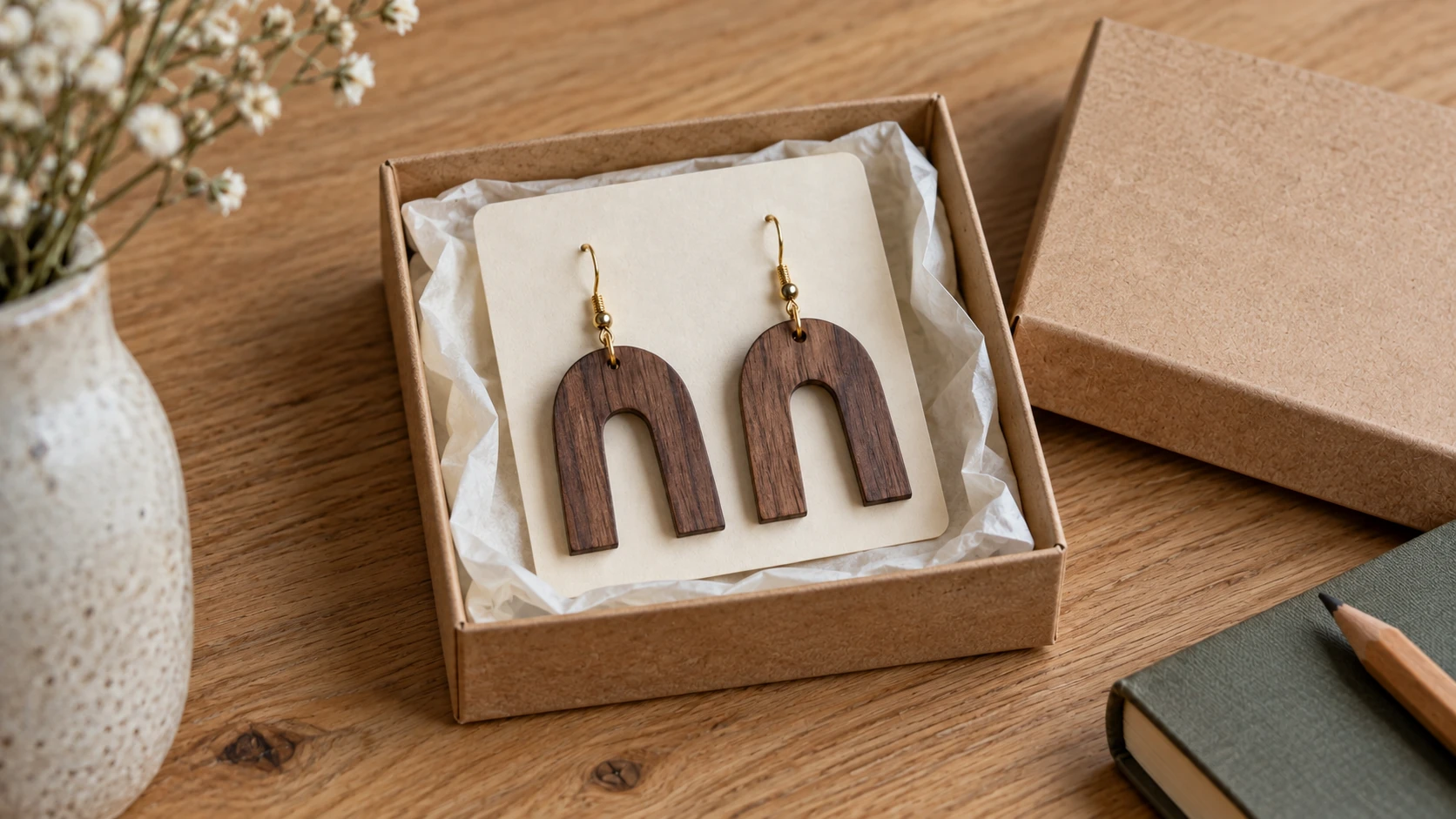
The presentation is part of the product experience and the cost. Include the card, box, tissue and packing time when calculating what the order costs you.
Storytelling
"Wood sign" is a product description. "Hand-engraved from reclaimed barn wood salvaged from a century-old farmhouse in rural Vermont" is a story. Stories create emotional connections, and emotional connections justify higher prices.
Talk about your process. Mention the materials and where they come from. Share why you started making things. People pay more when they feel connected to the maker.
Scarcity and Seasonality
Limited editions and seasonal items naturally command premiums. "Only 25 available" creates urgency. "Holiday collection, available through December" gives customers a deadline. These aren't manipulative tactics. They reflect the genuine reality that your time and production capacity are limited.
Tip
Use ListingLab to generate SEO-optimized listing descriptions that highlight your product's unique value. Well-written copy that tells your product's story justifies higher prices and converts more browsers into buyers. Text generation uses chatbot messages (not credits), so you can iterate on your descriptions easily.
Pricing Formulas at a Glance
Here's a quick reference for the main pricing strategies:
| Strategy | Formula | Best For |
|---|---|---|
| Cost-based | Materials + Labor + Overhead + Profit Markup | Setting your minimum viable price |
| Wholesale | Cost-based price (sell to retailers at this price) | Retail partnerships, consignment |
| Retail | Wholesale x 2 | Direct-to-consumer sales (Etsy, craft fairs, your website) |
| Perceived value | Cost-based price + value adjustments for personalization, branding, packaging | Premium and custom products |
| Bundle pricing | Individual prices added together minus 10-15% | Encouraging larger orders, gift sets |
Most successful makers use a combination. Start with cost-based to set your floor, check it against the market, then adjust upward based on perceived value.
Common Pricing Mistakes
These are the traps that catch almost every maker at some point. If you recognize yourself in any of these, it's time for a pricing review.
1. Not counting your time. This is the most common and most damaging mistake. If you made something in 3 hours and only charge for materials, you're working for free. Would you accept a job that pays $0 per hour? Then don't accept it from yourself.
2. Forgetting platform fees. Etsy's fee structure adds up fast. Listing fees, transaction fees, payment processing, and offsite ads (which Etsy can enroll you in automatically if you're under its revenue threshold) all take a bite. The exact total varies by your country and order value, so check Etsy's current fee schedule and build it into your math. If you didn't account for that in your pricing, you're eating it out of your profit.
3. Pricing based on materials only. "It only cost me $8 in wood, so I'll charge $20." That math ignores your labor, your overhead, your skill, and the years you spent learning. Materials are usually just one piece of what a product should cost, and often a small one compared to your time and expertise.
4. Matching the cheapest competitor. The cheapest seller on Etsy is not your competition. They're probably losing money and will quit within a year. Your competition is the mid-to-high tier sellers who are running sustainable businesses.
5. Not raising prices as skills improve. The cutting board you make today is dramatically better than the one you made two years ago. Your prices should reflect your current skill level, not the skill level you had when you started.
6. Offering too many discounts. A sale every now and then is fine. A permanent 20% off coupon trains your customers to never pay full price. Discounts should be strategic and temporary, not a constant crutch.
When to Raise Your Prices
Raising prices feels scary. But there are clear signals that it's time:
You're consistently sold out. If everything you list sells within hours or days, demand exceeds your supply. That's the textbook definition of "your prices are too low." Raise them until sales slow to a manageable pace.
Your skills have improved. Look at your work from a year ago compared to today. If there's a noticeable quality difference (and there almost certainly is), your pricing should reflect that improvement.
Material costs have gone up. Wood, acrylic, vinyl, shipping supplies: they all get more expensive over time. If your costs have increased but your prices haven't, your margins are shrinking with every sale.
You're burned out. This is the most important signal. If you dread opening your shop, if fulfilling orders feels like a grind, if you're considering quitting, your prices are probably too low. You're working too hard for too little return.
When you do raise prices, go up 10% to 20% at a time. Gradual increases are easier for existing customers to absorb, and they give you data on how price changes affect demand. Don't jump 50% overnight unless you're correcting a serious underpricing problem.
Info
Test your increase in stages and watch what actually happens: conversion rate, order volume, and whether repeat customers keep buying. That data tells you far more than guessing in advance how buyers will react.
Price for Profit, Not Applause
Your time has value. Your skills have value. The years you spent learning your craft, the equipment you invested in, the late nights perfecting your technique: all of that deserves fair compensation.
Nobody ever built a sustainable maker business by being the cheapest option. The makers who thrive are the ones who price their work fairly, invest in presentation, and aren't afraid to charge what their products are worth.
Do the math. Know your costs. Research your market. Then price with confidence.
Your future self (the one who's still making things a year from now instead of burned out and bitter) will thank you.
Once your pricing is dialed in, put it in front of buyers with listings that match. ListingLab generates SEO-optimized titles, descriptions, and AI product photos so your pricing has the presentation to back it up.
Related Tools
Ready to try these tools?
Sign up free, no credit card required. Free tools available immediately.
Start Free