How to Sell at Craft Fairs: Setup, Display, and Sales Tips for Makers
Selling online is great. You list a product, someone finds it, money appears in your account while you're asleep. Hard to beat that.
But there's nothing like watching someone pick up your product, turn it over in their hands, and say "I need this." That moment doesn't happen through a screen. It happens at a folding table in a church parking lot, or under a pop-up tent at a Saturday morning market.
Craft fairs bridge the gap between maker and customer. You get instant feedback, real conversations about your process, and cash in your pocket the same day. This guide covers finding the right events, setting up a booth that sells, planning inventory, and turning fair customers into repeat online buyers.
Finding the Right Craft Fairs
Not all craft fairs are worth your time. A poorly attended show in a bad location will cost you a day of your life and a booth fee with nothing to show for it. Choosing the right events matters more than almost anything else.
Juried vs. Open Shows
Juried shows require you to submit photos of your work for review. They attract better foot traffic because shoppers know the quality is curated. Booth fees are higher ($100 to $400+), but so are sales. They also limit how many vendors sell similar products, which means less direct competition.
Open shows accept anyone who pays the booth fee ($25 to $100). Easier to get into, but quality is inconsistent. You might end up next to someone selling mass-produced imports.
Both have their place. Open shows are great for getting started. Juried shows are where you aim once your products and presentation are polished.
Indoor vs. Outdoor
Indoor shows eliminate weather risk and don't require a tent. Booth spaces tend to be smaller, and foot traffic depends on the venue's draw.
Outdoor shows get higher foot traffic from casual passersby, but weather is always a gamble. Wind, rain, and direct sun can all ruin your day. If you go outdoor, invest in a sturdy pop-up canopy with weights and have a weather backup plan.
Where to Find Events
- Local Facebook groups. Search "[your city] craft fairs" or "[your city] makers market." These groups are often the first place events get posted.
- Eventbrite. Search for craft fairs, artisan markets, and maker events in your area.
- Craft fair directories. Sites like FestivalNet and Fair Finder list events by region.
- Local chambers of commerce. Many community events are organized through the chamber. Check their events calendar.
- Instagram. Follow local market organizers and venue accounts. They announce vendor applications there.
Start Small
Your first craft fair should not be a $300 juried show in a major city. Start with low-stakes events: church bazaars, school fundraisers, neighborhood farmers markets. Booth fees are low ($25 to $75), the atmosphere is forgiving, and you'll learn more from one small fair than from months of planning.
Apply early for juried shows. Popular events fill up three to six months in advance. If you see a show you like in October, the application probably closed in July.
PRINT. CUT. CARVE.
- Multiple formats (SVG, DXF, PNG)
- Machine-tested designs
- Commercial licenses
Sponsored by PrintCutCarve.com
Booth Essentials (What to Bring)
Forgetting something at a craft fair is a rite of passage. But forgetting the wrong thing can cost you sales. Here's the full list.
Tables and tablecloths. Confirm with the organizer whether tables are provided. Bring a tablecloth that reaches the ground on all visible sides. This hides backup inventory underneath. A wrinkled bedsheet does not count.
Display stands and risers. Wooden crates, small shelves, plate stands, acrylic risers. You need height variation on your table (more on this below).
Signage. A business name banner readable from 15 feet. Price tags on every item. A "handmade by" story card in two sentences. People buy from people, not anonymous tables.
Payment processing. Square reader, Stripe Terminal, or similar. Most buyers expect to pay by card. Still bring a cash box with at least $50 in small bills. The person who hands you a $50 bill for a $12 item at 9:05 AM is inevitable.
Bags and packaging. Paper or kraft bags for purchases. Nobody wants to carry a naked wooden sign through a crowded market.
Business cards. Include a QR code linking to your online shop. More on this in the follow-up sales section below.
The "always needed" kit. Extension cord, tape, zip ties, scissors, Sharpie, small toolkit. You'll use at least three of these every time.
Personal supplies. Water, snacks, sunscreen (outdoor shows), phone charger. You'll be standing for 6 to 8 hours.
Tip
Create business cards with QR codes using the free QR Code Generator. Link directly to your Etsy shop, Instagram, or a product care page. One scan and they're a follower or repeat customer. For more ideas, check out QR codes for makers.
Display Tips That Sell
Your display is your storefront. In a sea of tables, you have about three seconds to catch someone's eye as they walk past. A flat table covered in products all at the same height is basically invisible from ten feet away.
Height Variation Is Everything
Create multiple levels. Use risers, wooden crates, small shelves, plate stands, or stacked books under the tablecloth to create elevation changes. Your table should have items at three or four different heights.
When someone approaches a row of vendor tables, they see a wall of flat surfaces. The booth with vertical variation stands out. It looks more professional, more interesting, and it lets you fit more product without looking cluttered.
Grouping and Layout
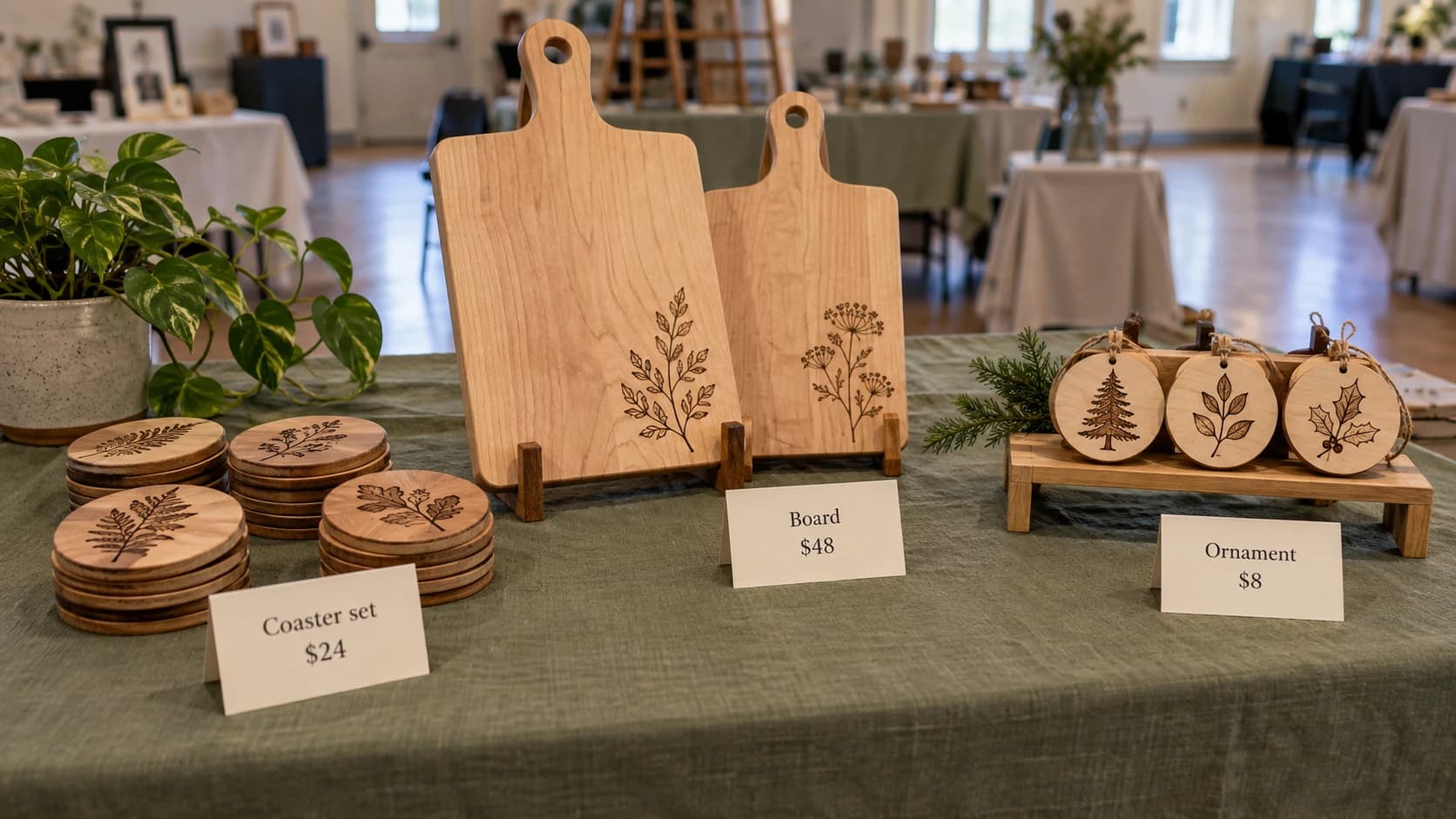
Group products by type or theme, not randomly. All the coasters together, all the ornaments together. This helps shoppers find what interests them and makes your booth look organized rather than like a garage sale.
Put best sellers at eye level toward the front. Smaller items go lower. Custom order samples can go to the sides.
Show Products in Context
A coaster sitting alone on a table is a piece of wood. A coaster with a coffee mug on it is a product someone can imagine using. A sign on a small easel looks like wall art. You don't need elaborate setups. Just a few props that help people see your product in their life.
Limit Your Choices
Counterintuitive, but fewer product types often leads to more sales. Three to five categories is the sweet spot. A booth with coasters, cutting boards, and ornaments tells a clear story. A booth with coasters, jewelry, candles, soap, keychains, and magnets looks like a flea market. Too much variety creates decision paralysis.
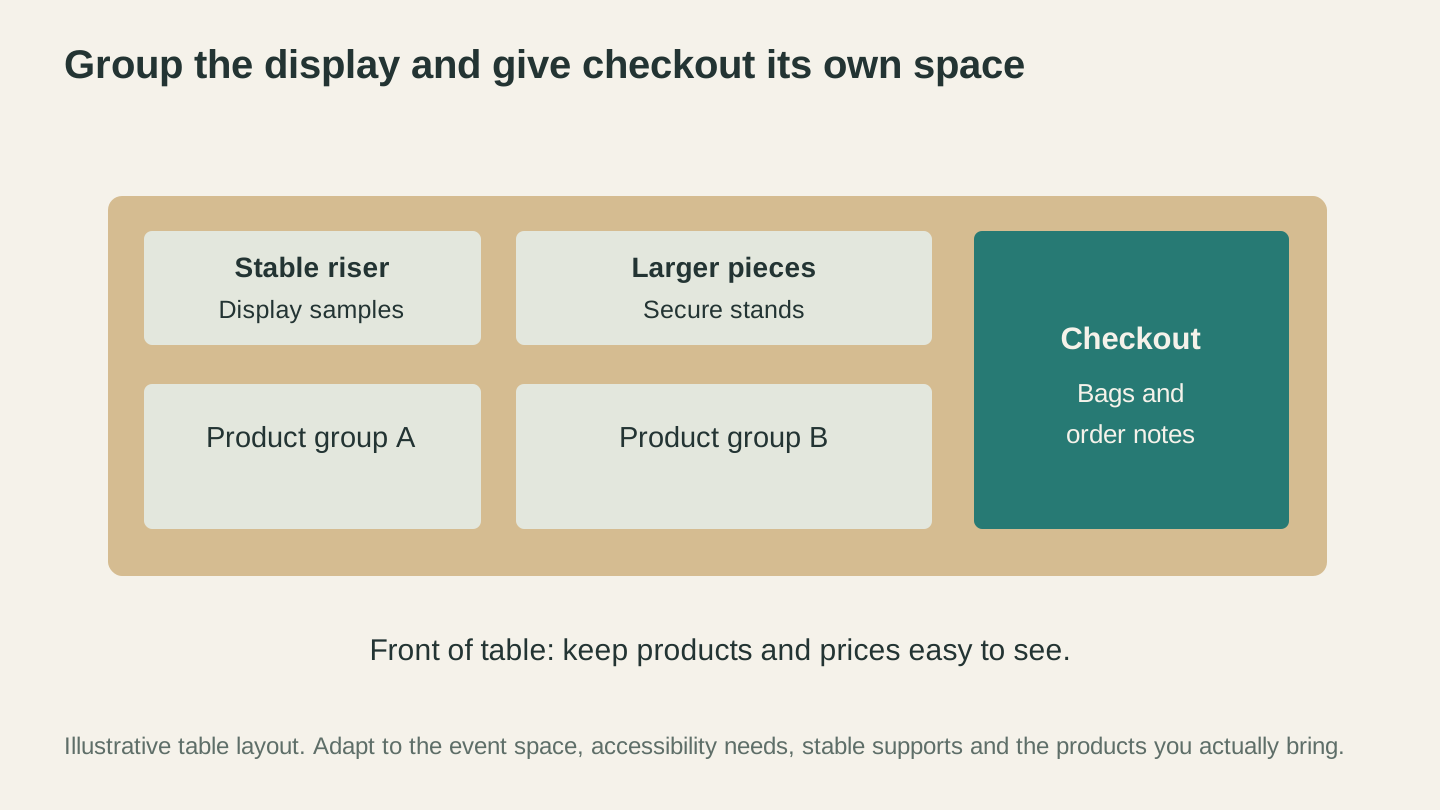
Group related products and leave a clear place to handle purchases. This is a layout example; adapt it to the space, stable supports and accessibility needs at your event.
Pricing and Signage
Price Everything
Price every single item. No exceptions. No "ask me for pricing." No blank tags.
Here's what happens when something isn't priced: a customer picks it up, looks for a price, doesn't find one, puts it back down, and walks to the next booth. They don't ask. They just leave. Every unpriced item is a lost sale you'll never know about.
Make Prices Clear and Consistent
Use clean, legible price tags. Printed labels, chalkboard tags, or neat handwritten cards all work. What doesn't work: tiny stickers, masking tape with faded Sharpie, or prices written on the bottom of items. Keep the style consistent. Matching tags signal professionalism.
Use Tiered and Bundle Pricing
Set up a "Good/Better/Best" display with three price points for similar items. A small sign for $25, a medium for $45, a large for $65. Most people pick the middle option, which is exactly what you want.
Bundle pricing works remarkably well at craft fairs. "3 coasters for $25" outsells "$10 each" even though the math is almost the same. Bundles feel like deals, and they increase your average transaction size.
If you want to dig deeper into pricing strategy, our guide to pricing handmade products covers cost-based formulas, perceived value pricing, and common mistakes that eat your profits.
Write Descriptions That Connect
Small signs next to product groups help people understand what they're looking at. "Hand-engraved on solid maple" is better than just a price. A two-sentence story card about your process adds personality and gives shoppers a reason to choose you over a similar product at another booth.
ListingLab can help you generate compelling product descriptions and key selling points. While it's designed for online listings, the same language works great on craft fair signage and story cards.
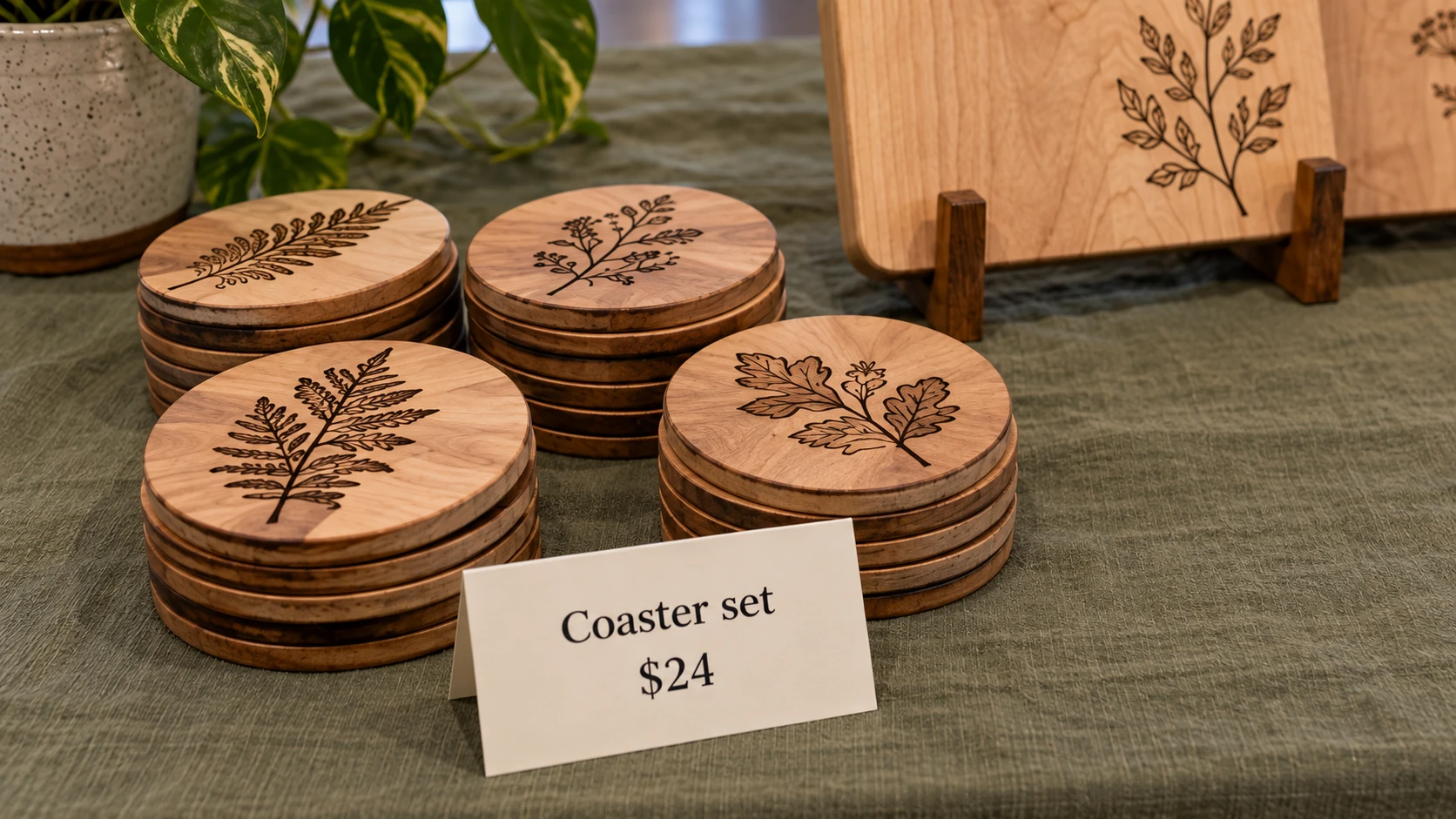
The same display up close puts the price beside the products it describes. The amount is an illustrative display price, not a recommended selling price.
Inventory Planning
Bringing the right amount of inventory is an art. Too little and you sell out by noon. Too much and you haul heavy boxes back to your car feeling deflated.
The 3-5x Rule
Bring three to five times your booth fee in retail inventory value. If your booth costs $200, bring $600 to $1,000 worth of product. For best sellers, bring 10 to 20 units. For experimental or high-priced items, bring 3 to 5.
Personalized and Custom Items
Personalized items are the biggest advantage handmade sellers have over mass production. Bring samples and take orders. Display one beautifully finished example with a "Custom orders welcome" sign.
Don't try to engrave or cut on-site unless you've practiced extensively with a portable setup. On-site production introduces a dozen failure points: power availability, noise restrictions, dust, and the pressure of someone watching you work.
Take orders on a notepad. Collect a name, contact info, customization details, and payment. Ship or arrange local pickup later. For popular personalized product ideas, check out our personalized gifts guide.
Day-of Sales Tips
Your products are great and your display looks professional. Now it's about the human stuff.
Stand up. The single biggest difference between booths that sell and booths that don't is whether the person behind the table is standing or sitting in a chair scrolling their phone. Standing signals you're open for business. Sitting signals "please don't bother me."
Greet people, but don't pounce. Make eye contact, smile, say hello. Then give them space. "Let me know if you have any questions" is the perfect amount. Don't launch into a sales pitch the second someone glances at your table.
Have a one-liner ready. "Everything's handmade with a laser engraver" or "Those are cut from solid walnut" is friendly and informational without being pushy. It gives them a hook to ask follow-up questions.
Offer gift wrapping. At holiday fairs especially, wrapping purchases in tissue paper or a small gift bag costs almost nothing and makes buyers feel like they got extra service.
Take custom orders. "I love this, but do you have it in blue?" is a custom order waiting to happen. Have a notepad ready. Get their contact info and details. Follow up within 24 hours.
Track what sells. Take a photo of your table at the start and end of the day. Knowing what moved tells you exactly what to bring more of next time.
Info
Your first few craft fairs are market research. Pay attention to which products people pick up, what questions they ask, and what price points generate the least hesitation. This information is worth more than the sales themselves.
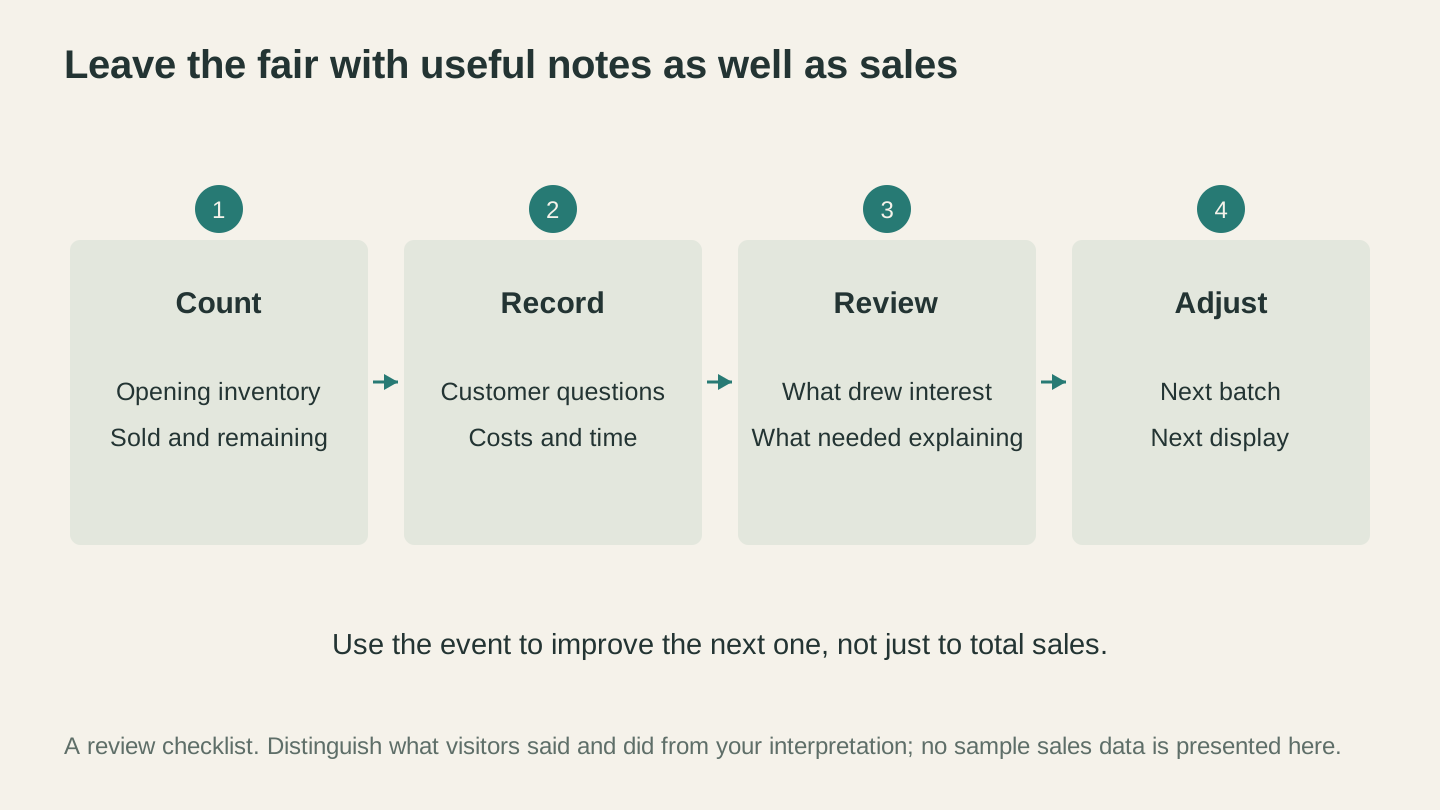
Keep notes on what visitors picked up, asked about and bought. Those observations can guide the next batch and display.
Driving Online Follow-Up Sales
The real value of a craft fair isn't just the day's sales. It's the customers you convert into repeat online buyers. Someone who buys a $15 coaster at a market and then orders $200 in holiday gifts from your Etsy shop over the next year is the outcome you're playing for.
Turn Every Purchase Into a Connection
Include a business card or thank-you card in every bag. Every bag, every time. The card should have your shop URL, social media handle, and a QR code linking to your online shop.
Nobody is going to type a URL into their phone. A QR code they can scan in two seconds converts at a dramatically higher rate. Use the free QR Code Generator to create codes that link wherever you need them.
Offer a Follow-Up Incentive
A card that says "10% off your next order" with a QR code to your shop is simple and effective. Create a discount code specifically for craft fair customers so you can track how much online revenue your events generate.
Build Your Email List
Collect signups at the fair. A clipboard with "Join our list for early access to new products" works. "Sign up and enter to win a free [your product]" works better. An email address is more valuable than a social media follower. You own that connection without fighting an algorithm.
Encourage Social Media Follows
Display your Instagram handle prominently. A QR code linking to your profile makes it effortless. Encourage people to tag you when they post photos of their purchases.
For more strategies on converting fair customers into online buyers, our Etsy selling guide covers building an online presence that supports in-person sales. And our QR codes for makers guide has specific ideas for packaging, business cards, and marketing materials.
Your First Fair Won't Be Perfect
Your first craft fair will be awkward. Your display won't be perfect. You'll forget something. That's fine. Every successful craft fair seller started with a folding table and too much inventory. They learned what works by doing it, adjusting, and doing it again.
The hardest part is showing up for the first time. Everything after that is just iteration.
Find a small local event, pay the booth fee, load up your car, and go sell the things you make. You'll walk away with lessons that no blog post, including this one, can teach you.
Before you go, put a QR code on your business cards and price tags with the free QR Code Generator so every sale can turn into a follow. And when you're ready to list your best sellers online, ListingLab can turn a product photo into titles, descriptions, and keywords in minutes.
Related Tools
Ready to try these tools?
Sign up free, no credit card required. Free tools available immediately.
Start Free