
How to Price Custom and Commission Work
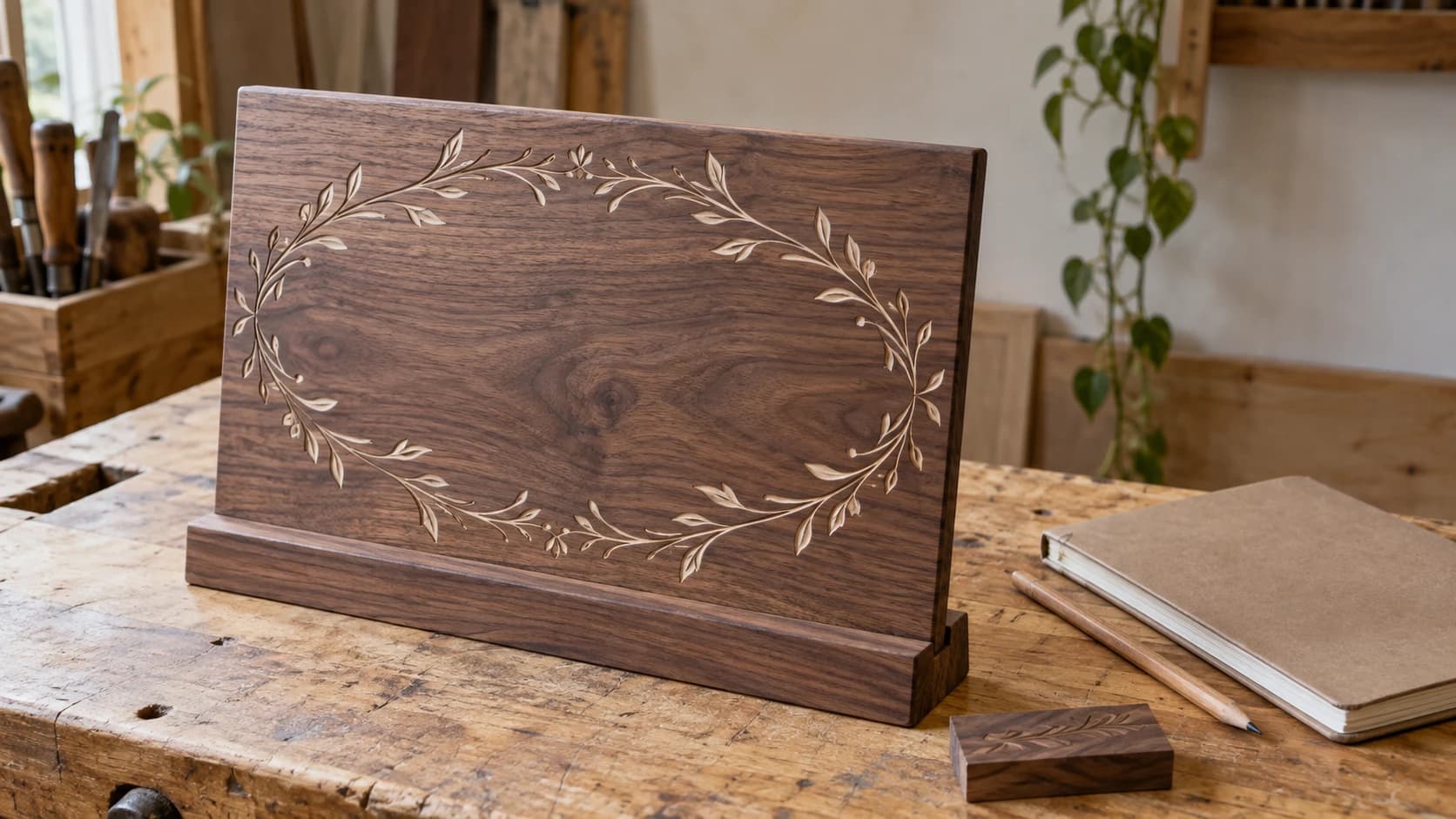
Someone messages you: "I love your work. Could you make me something like this, but with our farm's logo, in walnut, about twice the size?" And then the sentence that ruins your evening: "What would that cost?"
You stare at the message for ten minutes. Quote too high and you lose them. Quote too low and you spend three weekends resenting a piece of walnut. Most makers split the difference badly: they guess a number that sounded fine in the moment, then discover mid-project that the guess covered the wood and roughly nothing else.
This post is a system for that message. Not for pricing the coasters you make forty at a time. For pricing the one-off: the commission, the custom sign, the "could you just" project that exists nowhere until you invent it.
Tip
Short answer: Quote custom work as materials + machine time + design time + finishing + markup, all of it, including the design hours. Take a deposit before you start, state your revision limit in the quote, and deliver the price as a plain statement, not an apology.
Custom Work Is a Different Pricing Problem
If you sell a repeatable product, you price it once and the math amortizes. Design the coaster once, sell it two hundred times, and the design cost per coaster rounds to pocket change. That is a solved problem, and our guide to pricing handmade products walks through it: cost of goods, hourly rate, wholesale versus retail, all of it. If that is what you are pricing, go read that one.
A commission breaks that math in one move: there is no two hundred. Every hour you spend designing this piece is spent on exactly one sale. The customer conversation, the mockup, the revision, the test cut on scrap: one sale absorbs all of it.
Which means the classic product formula quietly lies to you on custom work. It was built assuming design cost spreads across a production run. On a run of one, "spread across the run" means "billed in full, to this person, on this quote." Makers who miss that end up charging product prices for commission work, and commission work is why they are tired.
The second difference is risk. A product either sells or it doesn't, and the worst case is inventory on a shelf. A commission can go sideways in ways a product cannot: the customer changes their mind halfway, the scope grows a little every message, the "quick tweak" turns into revision number six. Custom pricing is not just a number. It is a number plus the rules that protect it.
PRINT. CUT. CARVE.
- Multiple formats (SVG, DXF, PNG)
- Machine-tested designs
- Commercial licenses
Sponsored by PrintCutCarve.com
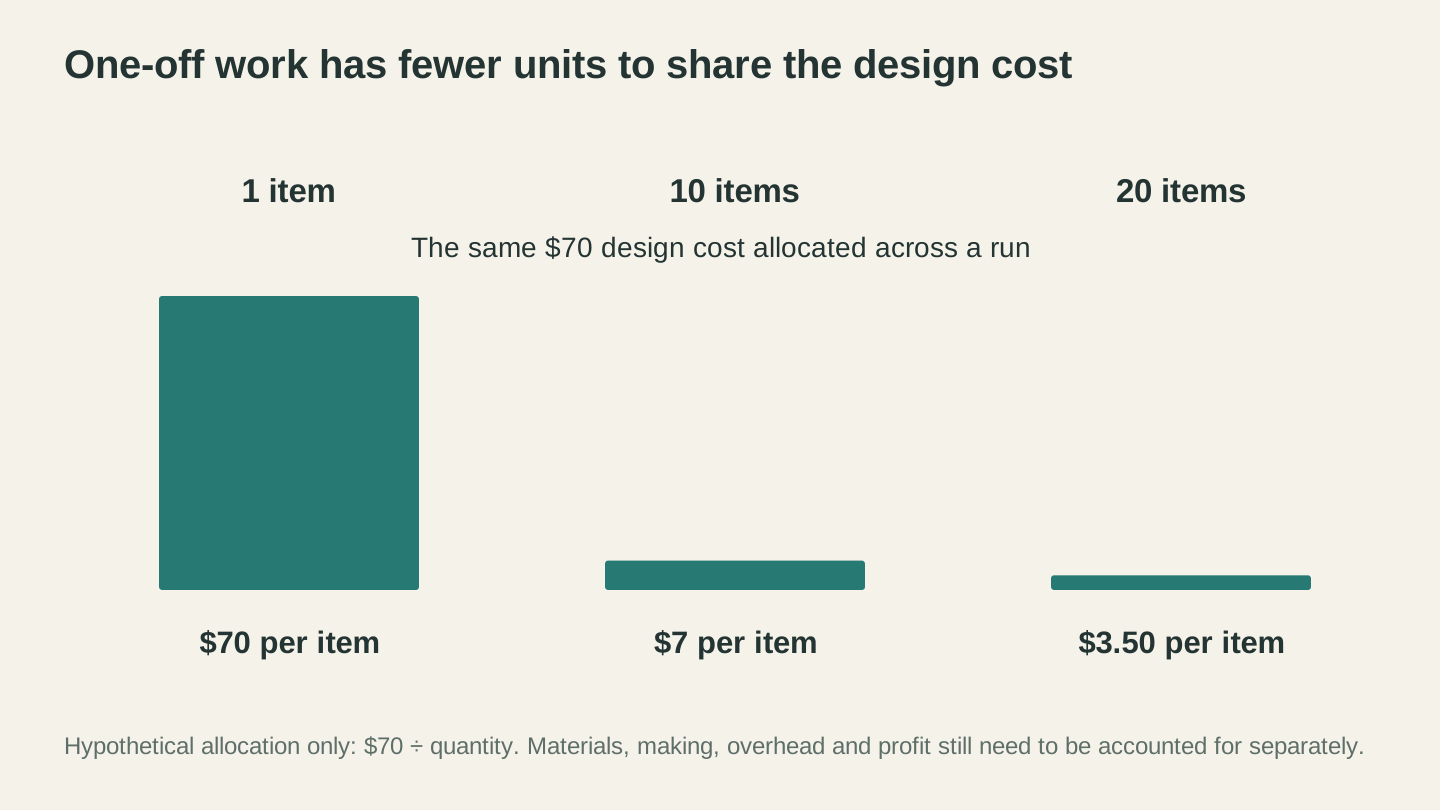
A fixed design cost falls per item when it is shared across a larger run. This example excludes production, materials and every other cost.
The Quote Framework
Every custom quote is the same five lines. Write them down every time, even when the job feels small, because the jobs that feel small are the ones that eat you.
1. Materials. Everything physical, at replacement cost, including the finish, the hardware, the packaging, and a waste allowance. Custom work burns more material than production work because you have no dialed-in file yet. If there is any real chance of a scrapped first attempt, price the material for two.
2. Machine time. Cutting, engraving, carving, printing. Charge an hourly rate for it even though you are not standing there the whole time, because the machine is wearing, the shop is occupied, and that hour is not available to any other paying job.
3. Design time. The big one. Every hour of drawing, vectorizing, mocking up, emailing, and testing. More on this in a second, because this is the line most makers delete.
4. Finishing and handling. Sanding, oiling, assembly, quality check, packing, the trip to the post office. On a small piece this is often more clock time than the machine time. Count it.
5. Markup. A percentage on top of all of the above. This is not greed, it is the buffer that absorbs the surprise: the board that cups, the glue-up that fails, the shipping quote that doubled. There is no universal number here: work yours out from your overhead, your risk on this particular job, and your market. If you want a number to start experimenting from, try something in the 15 to 30 percent range and adjust it as real jobs teach you where your surprises live. Without that buffer, one surprise turns a paid weekend into a free one.
Here is the shape of it, with invented numbers. This is an illustrative example, not a real quote from a real job, so swap in your own rates and costs:
| Line | Illustrative math | Amount |
|---|---|---|
| Materials (walnut blank, oil finish, packaging, waste allowance) | at replacement cost | $25 |
| Machine time | 1.5 hr at $20/hr | $30 |
| Design time | 2 hr at $35/hr | $70 |
| Finishing and handling | 1 hr at $35/hr | $35 |
| Subtotal | $160 | |
| Markup | 20% | $32 |
| Quote | rounded | $195 |
Notice what happened: design time is the largest single line. On most commissions it is. That is not a mistake in the math. That is the math telling you what a commission actually is: mostly design, with some cutting at the end.
Info
Talking a quote through out loud helps more than staring at it. Craft Chat is free to use within your plan's monthly message limits, and it is a decent rubber duck for this: paste in your five lines and ask what you forgot. It will not know your local walnut prices, but "what costs am I missing on a custom sign commission?" is exactly the kind of checklist question it is good at.
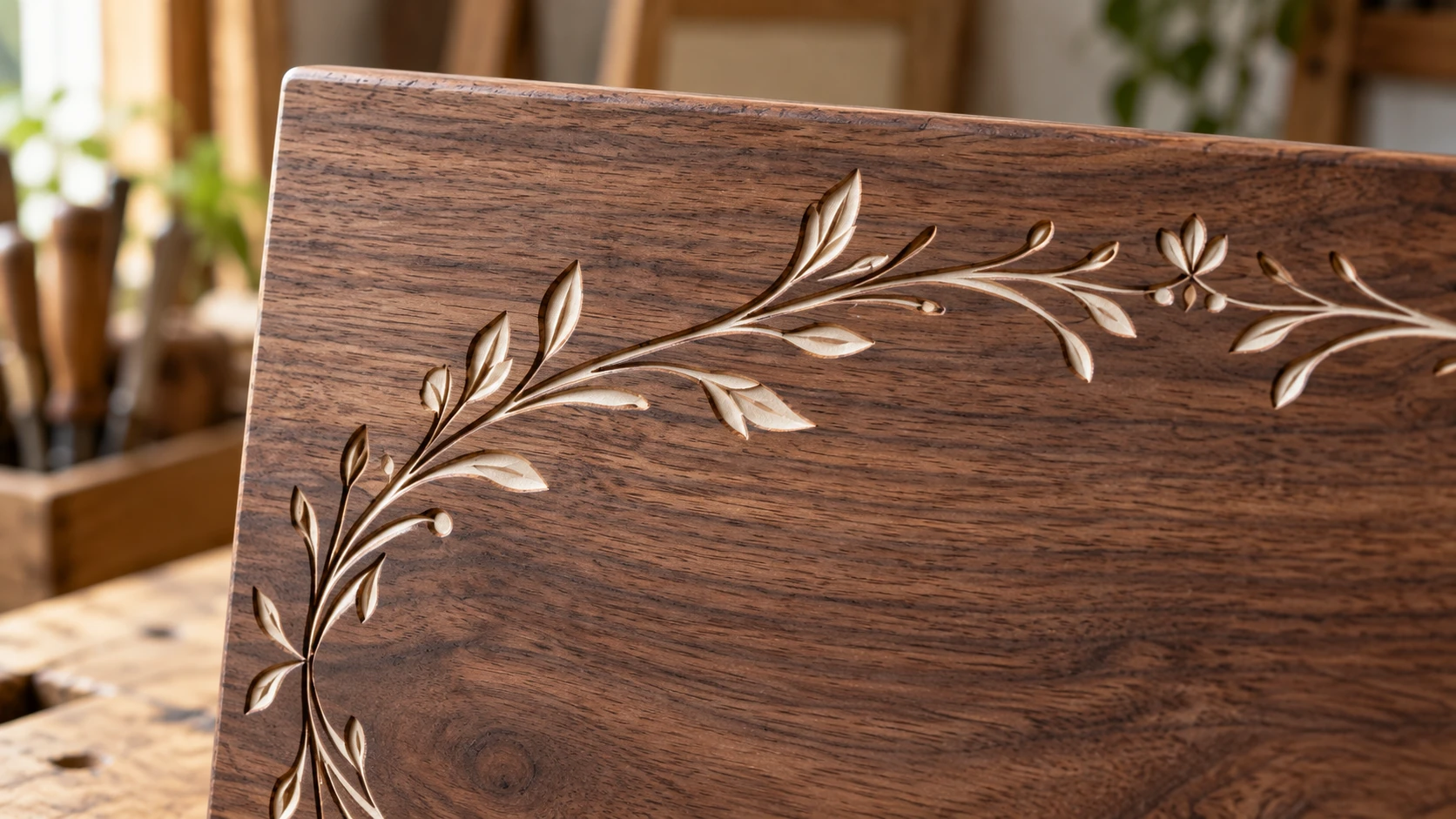
Design, test cuts and careful finishing all take time. The closer view shows the sort of detail that a custom quote needs to account for.
Design Time Is Billable. All of It.
Here is the mental trap: the customer pays for an object, so makers price the object. The design work feels like something you did on the way to the "real" work, like it should be free because no sawdust was produced.
Flip it around. If the customer took your finished design file to another shop, that shop could cut the piece in an hour. The design is most of the value. It is the part they could not do themselves, which is exactly why they came to you instead of buying something off a shelf.
So bill it like the skilled work it is:
- Track it honestly. Start a timer, or just note the clock, every time you touch the project. Include the messages. Especially include the messages.
- Bill the mockup phase too. The proof you send for approval is design work. Three mockup options is three chunks of design time, which is why "I made you five versions to choose from" is a gift you should stop giving.
- If revealing an hourly rate feels awkward, fold design into the quote as a single number. The customer sees "$195." You know $70 of it is design. Both of you are happy.
One caveat so you don't over-rotate: a rough ballpark before any real design work is a normal free step. "Something like that usually lands between $150 and $250, want me to work up a firm quote?" costs you two minutes and filters out the people who were imagining $40. The billable clock starts when the actual designing starts.
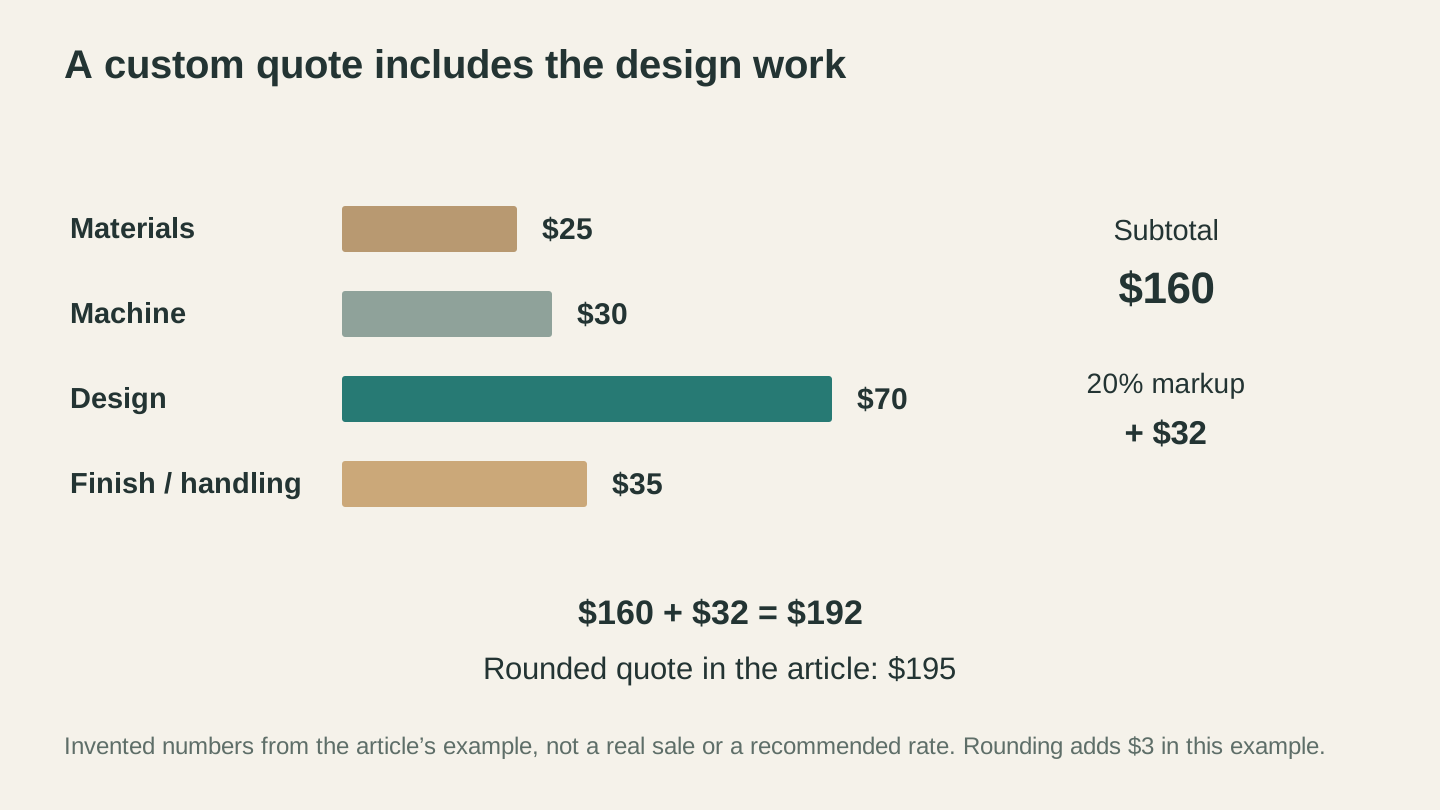
The article example totals $160 in costs. A 20% markup adds $32; rounding the resulting $192 quote to $195 adds another $3.
Deposits: The Non-Negotiable Part
Never start a commission without money down. Not for friends, not for repeat customers, not for the person who "definitely, 100%" wants it.
A deposit does three jobs at once:
- It proves the customer is real. A surprising fraction of enthusiastic commission requests evaporate the moment money is mentioned. Better to learn that before you have designed anything.
- It covers your materials and design time if the customer disappears mid-project. You should never be holding the full cost of someone else's half-finished idea.
- It changes the relationship. A person with money down responds to your proof email. A person with nothing down lets it sit for three weeks and then asks for changes.
A deposit of 30 to 50 percent up front is normal for one-off commission work, with 50 the usual choice when the design hours or material costs land early, and serious customers expect to be asked. For bigger jobs, a three-stage split works well: a third to start, a third at design approval, the balance before delivery or handoff. However you split it, one rule holds: the deposit at minimum covers materials plus the design hours you expect to spend, so a vanished customer costs you nothing but the daydream.
And put the refund terms in writing in the same breath. A common policy: the deposit becomes non-refundable once design work begins. Treat that as a starting template rather than a law of nature, since consumer rules on deposits vary by where you sell, and check what applies locally before you standardize the wording. Either way, a sentence written before anything starts replaces an extremely awkward conversation later.
Revisions: Set the Limit Before the First Mockup
Unlimited revisions is not generosity. It is an unpriced liability sitting inside your quote, and the customer controls how big it gets.
The fix is one sentence in every quote: "Price includes two revisions to the approved concept. Further revisions are billed at my design rate." Adjust the number to taste. The point is that the number exists, in writing, before the first mockup goes out.
What counts as a revision? Anything after you send a proof. "Make the name bigger" is a revision. "Actually, my wife prefers script fonts" is a revision. Fixing your own mistake is not a revision, that one is on the house, obviously.
Two things happen when you state the limit up front. First, customers consolidate their feedback, because vague reactions are free but change requests are finite. You get one thoughtful email instead of nine one-line messages. Second, the customers who would have been revision nightmares reveal themselves at quote time, when it is cheap to find out.
Warning
The most expensive phrase in commission work is "while you're at it." Each individual ask is small. "Could you add the date? While you're at it, maybe a small star? Oh, and could the back be engraved too?" None of them alone is worth an awkward conversation, and together they are five unpaid hours. The defense is a friendly reflex, used every time: "Sure, happy to add that! It's about $25 more and adds two days. Want me to include it?" If it is worth it to them, you get paid. If not, the scope holds. Either way, nobody is upset, because you never said no.
Rush Fees Are Real Fees
"I need it by Saturday" is a request to skip the queue, work your evening, and accept zero slack for anything going wrong. That is a premium service and it has a premium price: 25 to 50 percent on top of the normal quote is a reasonable range, scaled to how unreasonable the deadline is.
Two rules make rush fees painless. Say the fee without embarrassment, because expedited anything costs more everywhere else in the economy and your shop is not an exception. And only take the rush job if you can genuinely hit the date, because a rush fee on a missed deadline is the worst outcome available: you worked the late nights and still made someone's event without their centerpiece.
When to Say No
Some commissions should be declined, and the quote stage is where you find them. Decline when:
- The budget and the work cannot meet. If their number is half your bottom line, say so kindly and let go. Do not "just this once" your way into a resentful weekend, because just-this-once customers refer more just-this-once customers.
- The request is outside what you can do well. A commission is a promise. If you have never done inlay work, a paid deadline is a rough place to learn.
- The spec will not hold still. If the idea changes twice before you have even quoted, it will change six more times after. "It sounds like the vision is still coming together. Reach out when it settles and I'll quote it properly" is a complete answer.
- Your gut says no during the first exchange. The customer who is difficult at "hello" does not improve at revision three. The quote conversation is the cheapest exit you will ever get.
A clean decline keeps the relationship: "This one isn't a fit for my shop, but thank you for thinking of me." No essay, no fake excuse. Half the time they come back later with a project that is a fit.
Saying the Price Without Apologizing
You can do everything above and still lose the margin in the last ten seconds, at delivery of the number. The classic failure sounds like this: "So it'd be, um, probably around $195? But I could maybe do less if that's too much..."
That sentence invites a negotiation you did not need to have. The customer was not going to haggle until you flinched first.
Deliver the number the way a plumber does, as information: "That piece would be $195, with half down to get started, and about a three-week turnaround." Then stop talking. Silence after a price is not rudeness, it is the customer doing math, and interrupting their math with a discount is a habit to break this year.
A few upgrades that make delivery easier:
- Itemize lightly, not fully. "That covers materials, the design work, and the making" gives the number a skeleton without inviting line-item debate.
- Never apologize for design time. If someone balks at paying for design, that is the product-price customer, and they want a product, not a commission. Point them at your ready-made listings and part as friends.
- "That's more than I expected" is not an attack. It is often just true, because most people have never bought custom work before. "Totally fair! Custom pieces cost more than off-the-shelf because the design is made once, just for you" answers it honestly. Some will pay. Some won't. Both outcomes beat working below cost.
If phrasing is the part that trips you, this is another spot where Craft Chat earns its keep: draft the quote message, paste it in, and ask for a version that sounds confident without sounding stiff. Free within your monthly message allotment, and considerably cheaper than the discount you were about to volunteer.
Turning Commissions Into a Pipeline
One last pricing lever that has nothing to do with math: where the request comes from. A commission request from someone who found your polished listing arrives pre-sold on your quality and anchored to your prices. A request from a friend-of-a-friend arrives anchored to "you'd do this as a favor, right?"
So build the front door. A "custom orders" listing with sharp photos of past commissions, a starting-at price, and a clear process description does your negotiating before you ever join the conversation. ListingLab helps on both halves of that: it drafts the titles, descriptions, and search keywords from a photo of your work using your plan's chatbot messages rather than credits, and it can generate styled AI product photos for 1 credit each when your best commission left for its new home before you got a decent shot of it. If your custom listings live on Etsy, our Etsy seller's guide covers how personalization options and processing times fit that marketplace.
And if you do not yet have commission requests to price, that is the actual first problem: our guide to finding your first customers is the place to start, because everything in this post assumes someone has already asked.
The message that used to ruin your evening now takes fifteen minutes: five quote lines, a deposit, a revision limit, one confidently delivered number. The customer gets a professional. You get paid for all of the work, including the hours nobody sees.
Put it into practice this week: open ListingLab and draft the custom-orders listing that brings the next request to your door, then take your next quote to Craft Chat and rehearse the number until saying it feels boring. Boring is the goal. Boring gets paid.
Related Tools
Ready to try these tools?
Sign up free, no credit card required. Free tools available immediately.
Start Free