

How to Build a Brand Around Your Maker Business
You make great stuff. Your cutting boards are flawless, your laser engraved ornaments look professional, and your craft fair neighbors keep asking how you get such clean results. But when someone visits your Etsy shop, they see a random collection of products with different photo styles, no consistent look, and a shop name that was your first available username from 2019.
That's not a brand. That's a garage sale with internet access.
The difference between makers who sell a few items here and there and makers who build a real, sustainable business almost always comes down to branding. Not because branding is magic, but because it creates recognition, trust, and a reason for customers to come back instead of buying from the next shop in the search results.
This is the practical guide to building a brand around your maker business. Not corporate marketing theory. Not "hire a branding agency for $15,000." Just the things you can actually do, starting today, to make your business look like a business instead of a hobby that accidentally has a checkout button.
Why Branding Matters (Even for a One-Person Shop)
There's a persistent myth among makers that branding is for big companies. Nike, Apple, Starbucks. Companies with marketing departments and million-dollar ad budgets. "I'm just one person making things in my workshop" is the usual excuse for skipping it entirely.
But branding isn't about size. It's about being recognizable and memorable. When a customer buys a laser engraved cutting board from you and then, six months later, needs a housewarming gift, do they remember where they bought that great cutting board? If your shop looks like every other shop, the answer is no. They'll search Etsy again and buy from whoever shows up first.
PRINT. CUT. CARVE.
- Multiple formats (SVG, DXF, PNG)
- Machine-tested designs
- Commercial licenses
Sponsored by PrintCutCarve.com
The Math Behind Repeat Customers
Acquiring a new customer costs significantly more than keeping one. On Etsy, you're paying listing fees, transaction fees, and competing with thousands of other sellers for every click. A repeat customer bypasses all of that. They come directly to your shop because they remember you.
Here's the thing: people don't remember products. They remember brands. Think about the last handmade item you bought. Do you remember the specific product listing title? Probably not. But you might remember the packaging, the shop's look, the little note that came with it, or the shop name that stuck in your head.
That's branding. It's the sum of every impression you make on a customer.
Pricing Power
Unbranded products compete on price. When everything looks the same, buyers pick the cheapest option. A branded product competes on value, perceived quality, and emotional connection. Two identical wooden signs can sell at very different prices if one comes from "CraftedTimberCo" with beautiful packaging, a consistent visual style, and a story about the maker, while the other comes from "user29471" with a blurry photo.
If you've been struggling with the pricing side, our guide on pricing handmade products covers the math. But no pricing strategy works well without a brand that justifies the price tag.
Trust and Credibility
When someone lands on your shop or website, they decide within seconds whether it looks legitimate. A cohesive visual identity signals professionalism. Mismatched photos, inconsistent fonts, and a "we sell everything" approach signal the opposite.
This isn't about being fancy. It's about being consistent. A simple, clean brand that stays consistent across everything you do will always outperform an elaborate identity that changes with every listing.
Defining Your Niche: The Foundation of Everything
Before you pick colors, design a logo, or worry about packaging, you need to answer three questions. Everything else builds on these answers.
Question 1: What Do You Make?
This sounds obvious, but most makers answer it too broadly. "I make custom stuff" or "I do laser engraving" doesn't give a customer any reason to choose you over thousands of other shops.
Get specific. Not just "laser engraved products" but "personalized kitchen items for home cooks" or "custom pet memorial keepsakes" or "rustic farmhouse signs for new homeowners." The narrower your focus, the stronger your brand.
Info
Specialization feels risky because it means saying no to some customers. But it's actually less risky than trying to be everything to everyone. A shop known for one thing gets more word-of-mouth, ranks better on Etsy, and builds a loyal audience faster than a shop selling a random mix of unrelated items.
Does this mean you can never sell anything outside your niche? No. But your brand should have a clear center of gravity. If 80% of your products fit a clear theme and 20% are experiments or seasonal items, you still have a recognizable brand.
Question 2: Who Do You Make It For?
Your ideal customer is not "everyone." It's a specific person with specific needs, tastes, and buying habits. Think about who actually buys your products (or who you want to buy them).
Here are some examples of how different target customers shape everything about your brand:
| Target Customer | Product Focus | Brand Vibe | Price Range |
|---|---|---|---|
| New homeowners | Personalized home decor, address signs, custom art | Warm, welcoming, modern farmhouse | $30-100 |
| Pet owners | Memorial items, name signs, custom portraits | Emotional, heartfelt, comforting | $25-75 |
| Gift shoppers | Customizable items with gift wrapping | Polished, premium, giftable | $20-80 |
| Outdoor enthusiasts | Trail signs, camp gear, adventure decor | Rustic, natural, adventurous | $20-60 |
| Craft beer/wine fans | Custom tap handles, wine box engraving, coasters | Fun, casual, slightly irreverent | $15-50 |
Notice how the "brand vibe" column changes completely based on the audience. A shop selling pet memorial items should not have the same tone as one selling craft beer accessories. Your target customer determines your visual style, your voice, your photography, and your pricing.
Question 3: Why You?
This is where most makers freeze up. "Why would someone buy from me instead of the 500 other people selling similar things?"
Your answer doesn't need to be dramatic. It could be:
- Your materials. You use locally sourced hardwood, or food-safe finishes, or premium acrylic.
- Your process. You hand-finish every piece, or you use a specific technique that gives your work a distinctive look.
- Your customization. You offer options that bigger shops don't bother with.
- Your story. You started making to cope with a difficult time, or you're carrying on a family tradition, or you left a career to pursue making.
- Your standards. You test every piece, you ship faster, you include better packaging.
You don't need a tear-jerking origin story. You just need a genuine reason that helps customers connect with you instead of the competition.
Your Brand Name: Get It Right the First Time
Your shop name is the first thing people see and the last thing you want to change later. Renaming a business means losing recognition, confusing returning customers, and starting your SEO from zero. So spend some real time on this.
What Makes a Good Maker Brand Name
Easy to spell and say. If you tell someone your shop name at a craft fair and they can't find you on Etsy without asking you to spell it three times, the name isn't working. "WoodWhisper" is easy. "XyloKraftz" is not.
Hints at what you do. The name doesn't have to literally describe your products, but a subtle connection helps. "TimberLine Studio" suggests wood. "Ember & Edge" suggests laser work. "The Personalized Porch" suggests custom home decor. These names give browsers a reason to click.
Doesn't box you in too tightly. "Dave's Cutting Boards" works until you want to also sell serving trays, charcuterie boards, and coasters. Names that reference your craft, material, or vibe leave more room to grow than names that reference a single product.
Available across platforms. Before you commit, check that the name is available as an Etsy shop name, an Instagram handle, and ideally a .com domain. Consistency across platforms is part of branding, and having "TimberLineStudio" on Etsy but "TimberLine_Studio_Shop" on Instagram looks unprofessional.
Name Formats That Work
- Material + Concept: Timber & Grain, Stone Creek Designs, Iron Leaf Studio
- Action + Material: Carved Oak Co, Burned Edge Studio, Cut & Cure
- Adjective + Noun: Rustic Revival, Golden Grain Workshop, Simple Timber
- Place + Craft: Northwood Laser, Mountain Made Co, Valley Craft Studio
- Your Name + Descriptor: Mitchell Made, Sarah's Workshop, Harper & Co
Tip
Test your name by saying it out loud in these scenarios: "I got this from [name]." "You should check out [name] on Etsy." "This is from [name], they make amazing custom signs." If it sounds natural in conversation, it works. If it sounds forced or confusing, keep brainstorming.
Names to Avoid
- Random keyboard smashes: "Xzylon Craftwerx"
- Names with numbers: "Best Signs 247"
- Overly generic: "Custom Gifts Shop"
- Hard to pronounce: "Chiaroscuro Woodworks" (beautiful word, terrible shop name)
- Trademarked terms: Don't include brand names like "Cricut" or "Glowforge" in your shop name
Logo Design: Simple Wins
Every maker thinks they need a complex, beautiful logo. They spend weeks agonizing over intricate designs with ten colors and fine details. Then they put it on a business card and it turns into an unreadable blob.
The best logos are simple. Think about logos you actually recognize. Most of them are either a clean wordmark (the name in a specific font) or a simple icon plus the name. That's it.
The Maker Logo Hierarchy
Here's what to prioritize, in order:
Level 1: A good wordmark. Pick a font that fits your brand vibe, type your name in it, and use it consistently everywhere. This alone is better than 90% of maker logos. Cost: free.
Level 2: Wordmark plus a simple icon. Add a small symbol that represents your work. A leaf, a saw blade, a simple geometric shape, a flame. Keep it to one or two colors. Cost: $0-50 if you design it yourself.
Level 3: A professional custom logo. If your business is generating consistent revenue and you're ready to invest, hire a designer on Fiverr or 99designs. Budget $100-300 for something clean and professional. But don't do this until Level 1 and 2 have served you for at least six months.
Logo Rules for Makers
- Works in one color. Your logo will end up on invoices, packaging stamps, engraved products, and social media. If it only works in full color, it's too complex.
- Readable at small sizes. Your logo will appear as a tiny Etsy profile picture, a small Instagram avatar, and a stamp on packaging. If you squint at it on your phone and can't tell what it says, simplify it.
- No clip art. Using a stock image from Google as your logo is both unprofessional and potentially a copyright issue. If you can't design something original, a clean text-only wordmark is always better.
- Consistent usage. Once you have a logo, use the exact same version everywhere. Don't stretch it, don't change the colors from post to post, and don't redesign it every few months.
Free Logo Tools
You don't need expensive professional design software to make a solid maker logo. These free tools handle the job:
- A simple online design tool: Great for wordmarks and simple icon-plus-text logos. Look for one with plenty of built-in fonts.
- Google Fonts: Browse fonts by category to find one that fits your brand, then use it in your design tool of choice.
- A free vector editor: For more advanced logo work. Steeper learning curve but produces professional SVG files.
Building Your Color Palette
Color is the fastest way to make your brand recognizable. When someone sees your distinct color combination on an Etsy listing, an Instagram post, and a craft fair banner, the connection forms instantly.
Choosing Your Colors
You need 3-5 colors total. Here's the formula:
Primary color (1): Your main brand color. This appears on your logo, headers, and is the color people associate with you. Pick one that fits your brand personality.
Secondary color (1-2): Complements your primary color. Used for accents, buttons, secondary headings. Should look good next to your primary color without competing with it.
Neutral colors (1-2): Your background and text colors. Usually some combination of white/cream/light gray for backgrounds and dark gray/charcoal/black for text. These do the heavy lifting of keeping everything readable.
Color Personality Guide
| Brand Personality | Primary Colors | Good For |
|---|---|---|
| Rustic/Natural | Warm browns, forest greens, burnt orange | Wood products, farmhouse style |
| Modern/Clean | Navy, charcoal, white, single bold accent | Minimalist designs, tech-savvy audience |
| Feminine/Elegant | Blush pink, sage green, gold accents | Wedding items, jewelry, gift items |
| Bold/Fun | Bright teal, coral, yellow | Kids' items, playful products, pet products |
| Premium/Luxury | Black, gold, deep burgundy | High-end custom work, executive gifts |
| Outdoorsy/Adventure | Deep green, tan, slate blue | Camping gear, trail signs, outdoor decor |
Where Your Colors Show Up
Once you pick your palette, use it in every single customer touchpoint:
- Etsy shop banner and profile
- Product photography backgrounds or props
- Packaging (tissue paper, stickers, tape, boxes)
- Business cards and thank-you cards
- Social media post templates
- Craft fair booth setup (tablecloth, signage, banner)
- Your website (if you have one)
The point isn't to make everything look like a paint store. It's to create a subtle thread of visual consistency that ties all your materials together.
Tip
Take a screenshot of your Etsy shop, your Instagram profile, and your packaging laid out on a table. Put them side by side. Do they look like they're from the same brand? If not, your color palette (or lack of one) is the first thing to fix.
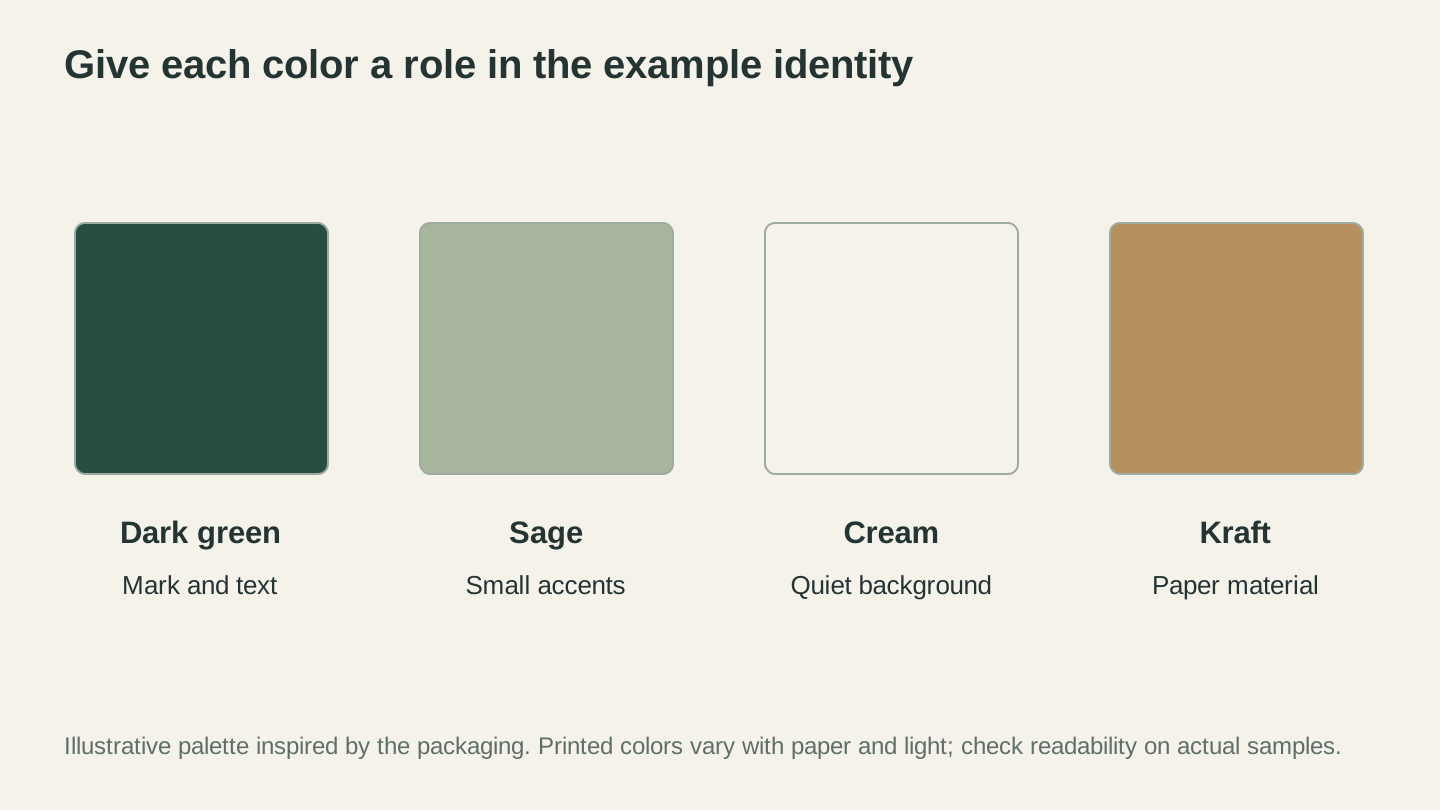
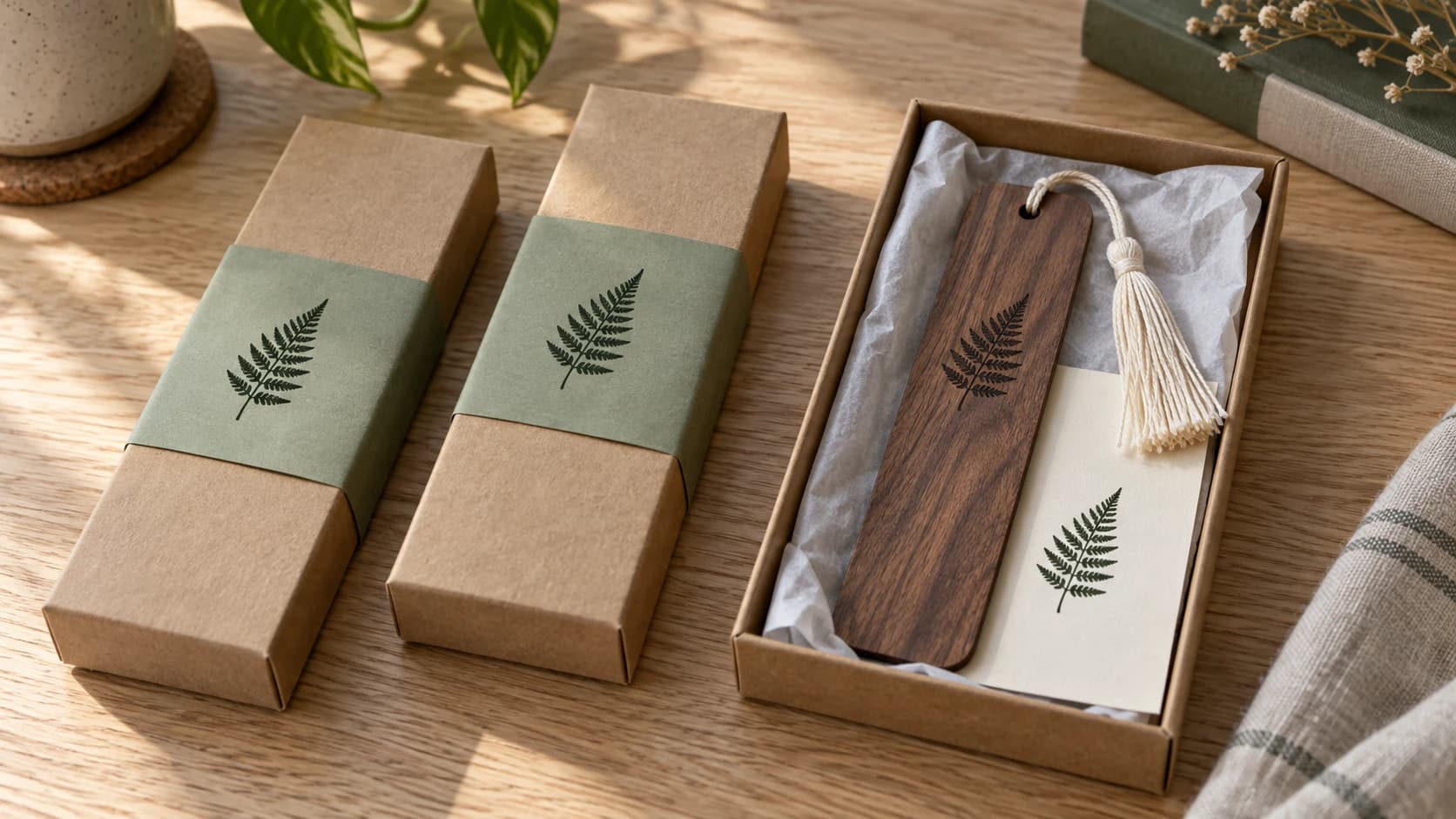
Assign each color a purpose. This example uses dark green for the mark and text, sage for accents, cream for space and kraft as the packaging material.
Typography: Fonts Matter More Than You Think
Most makers never think about fonts. They use whatever the default is in their design software, change it randomly for different products, and end up with a visual mess.
Fonts communicate personality just like colors do. A thick, blocky sans-serif says "modern and bold." A thin script font says "elegant and feminine." A slab serif says "sturdy and traditional." Your font choices should match the personality you've been building.
The Two-Font Rule
Pick two fonts and stick with them for everything:
Heading font: Used for your shop name, product titles, social media post headlines, and packaging headers. This is your personality font. It can be decorative, bold, or stylized.
Body font: Used for product descriptions, social media captions, and any longer text. This should be clean and easy to read. Save the personality for your headings.
That's it. Two fonts. If you want to get fancy, you can add a third accent font for special occasions, but two handles 95% of your needs.
Font Pairing Examples for Makers
| Brand Style | Heading Font (free) | Body Font (free) | Example Use |
|---|---|---|---|
| Rustic/Farmhouse | Playfair Display | Lato | Wooden signs, home decor |
| Modern/Minimal | Montserrat | Open Sans | Clean laser cut items |
| Vintage/Classic | Merriweather | Source Sans Pro | Traditional craft items |
| Fun/Playful | Fredoka One | Nunito | Kids' products, pet items |
| Elegant/Feminine | Cormorant Garamond | Raleway | Wedding items, jewelry |
All of these fonts are available for free on Google Fonts. Pick a pair, download them, and use them in whatever design tool you prefer.
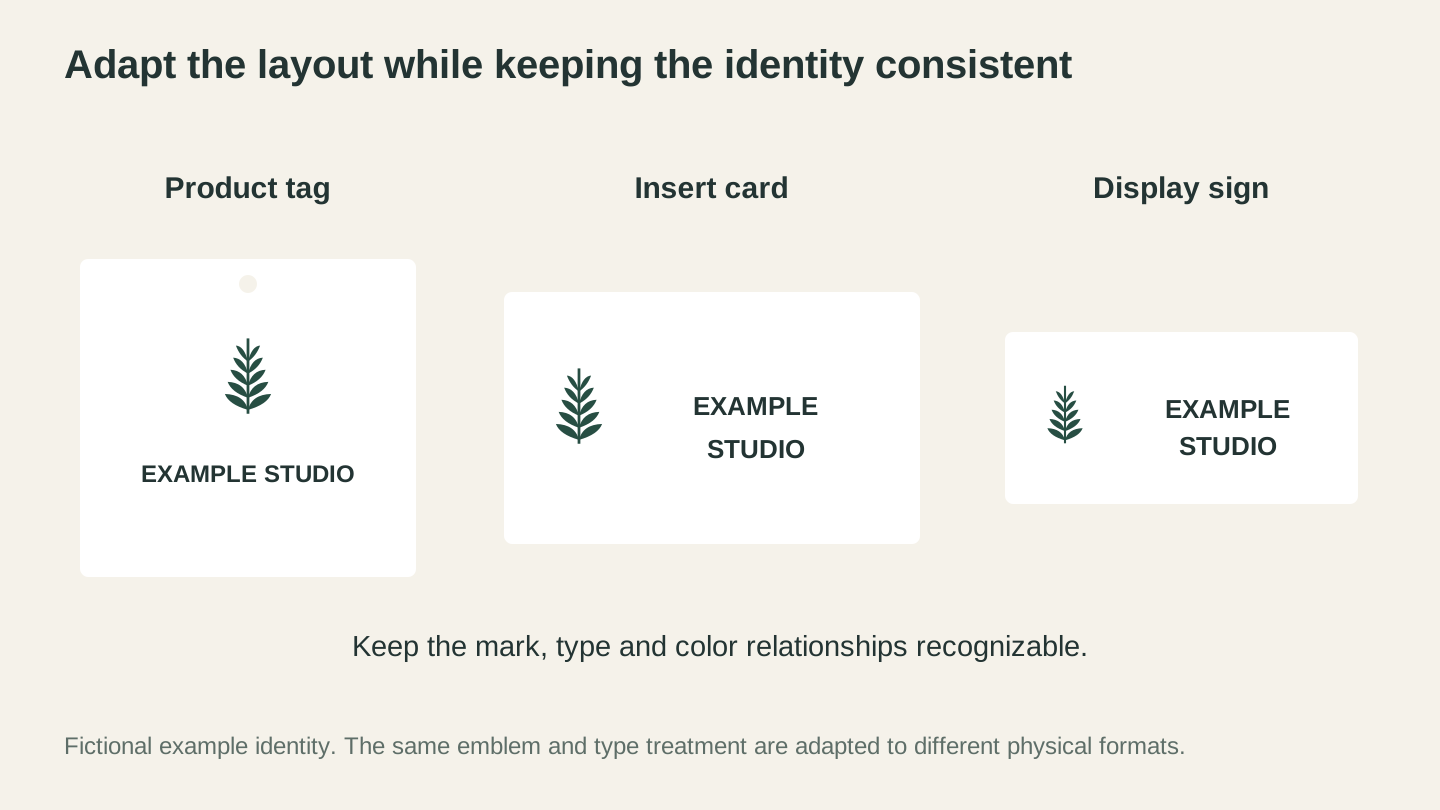
The layout can change with the format while the emblem, typography and color relationships stay recognizable. Example Studio is a fictional identity.
Photography Style: Your Secret Branding Weapon
If you read our guide on selling on Etsy, you know that product photography is the single biggest factor in whether someone clicks on your listing. But photography is also one of your most powerful branding tools.
When every photo in your shop has the same lighting, the same background style, and the same overall feel, your shop looks professional and cohesive. When your photos are a random mix of different lighting conditions, backgrounds, and angles, your shop looks like a flea market.
Creating a Consistent Photo Style
Pick a style and commit to it for at least your main product photos:
Light and airy. White or light backgrounds, lots of natural light, minimal props. Works well for modern, clean brands.
Dark and moody. Dark wood or slate backgrounds, dramatic side lighting, warm tones. Works well for rustic, premium brands.
Lifestyle context. Product shown in its intended setting (kitchen counter, wall, desk). Works well for home decor brands but requires more effort to keep consistent.
Flat lay. Product shot from directly above, arranged with props on a styled surface. Works well for smaller items and gift-oriented shops.
The Photo Consistency Checklist
For every product photo you take, keep these elements the same:
- Lighting direction. Always from the same side.
- Background. Same material, color, or setup.
- Angle. Primary photo always at the same angle.
- Editing. Same brightness, contrast, and warmth adjustments.
- Props. Consistent style (same wood tones, same greenery, same neutral accessories).
You don't need a professional studio. A corner of your workshop with a consistent background surface and a window for natural light is enough. The key word is consistent.
Reusable Photo Templates
For social media and listing images that include text (sale announcements, new product launches, behind-the-scenes posts), create a template in your design tool with your brand colors, fonts, and logo placement. Then duplicate that template every time you need a new graphic. This takes five minutes to set up and saves hours over time while keeping everything on-brand.
Packaging and the Unboxing Experience
Here's where most makers leave enormous branding potential on the table. Your packaging is the final physical touchpoint between you and your customer. It's the moment where you go from "random Etsy purchase" to "memorable experience I tell my friends about."
And it doesn't have to be expensive.
The Packaging Tiers
Tier 1: The Basics (cost: under $1 per order)
- Branded sticker on a kraft mailer or box (custom stickers from StickerMule or Sticker Giant, about $0.15-0.30 each)
- A printed thank-you card with your shop name, a short personal message, and your social media handles
- Clean, secure packaging that protects the product
This alone puts you ahead of 80% of Etsy sellers who ship in a plain brown box with no personality.
Tier 2: The Memorable Touch (cost: $1-3 per order)
- Branded tissue paper or crinkle cut paper in your brand colors
- Custom stamp with your logo on kraft paper or bags
- A small freebie (a sticker, a small sample item, a coupon code card)
- Handwritten note (even just "Thanks, Sarah! Hope you love it.")
Tier 3: The Wow Factor (cost: $3-8 per order)
- Custom printed boxes or mailers
- Branded ribbon or washi tape
- Magnetic closure gift boxes for premium items
- Custom printed packing tape
Warning
Don't jump to Tier 3 until you're consistently selling enough to justify the cost. Many makers invest heavily in packaging before they've validated their products. Start with Tier 1, get feedback, build sales volume, and upgrade when the math makes sense. Custom printed boxes usually require minimum orders of 100-500 units.
The Thank-You Card Strategy
Your thank-you card is a branding workhorse. Here's what to include:
- Your logo and shop name
- A brief, warm thank-you message
- Your social media handles (Instagram is usually the most valuable for makers)
- A review request ("If you love your [product], a review helps more than you know!")
- A QR code linking to your shop or a specific discount code
That last one is underrated. A QR code on your thank-you card gives the customer a frictionless path back to your shop when they're ready to buy again. No typing URLs, no searching Etsy. Just scan and shop.
You can create these QR codes for free with our QR Code Generator. Generate a QR code that links directly to your Etsy shop, your Instagram, or a custom landing page. Then add it to your thank-you cards, business cards, or even your product packaging.
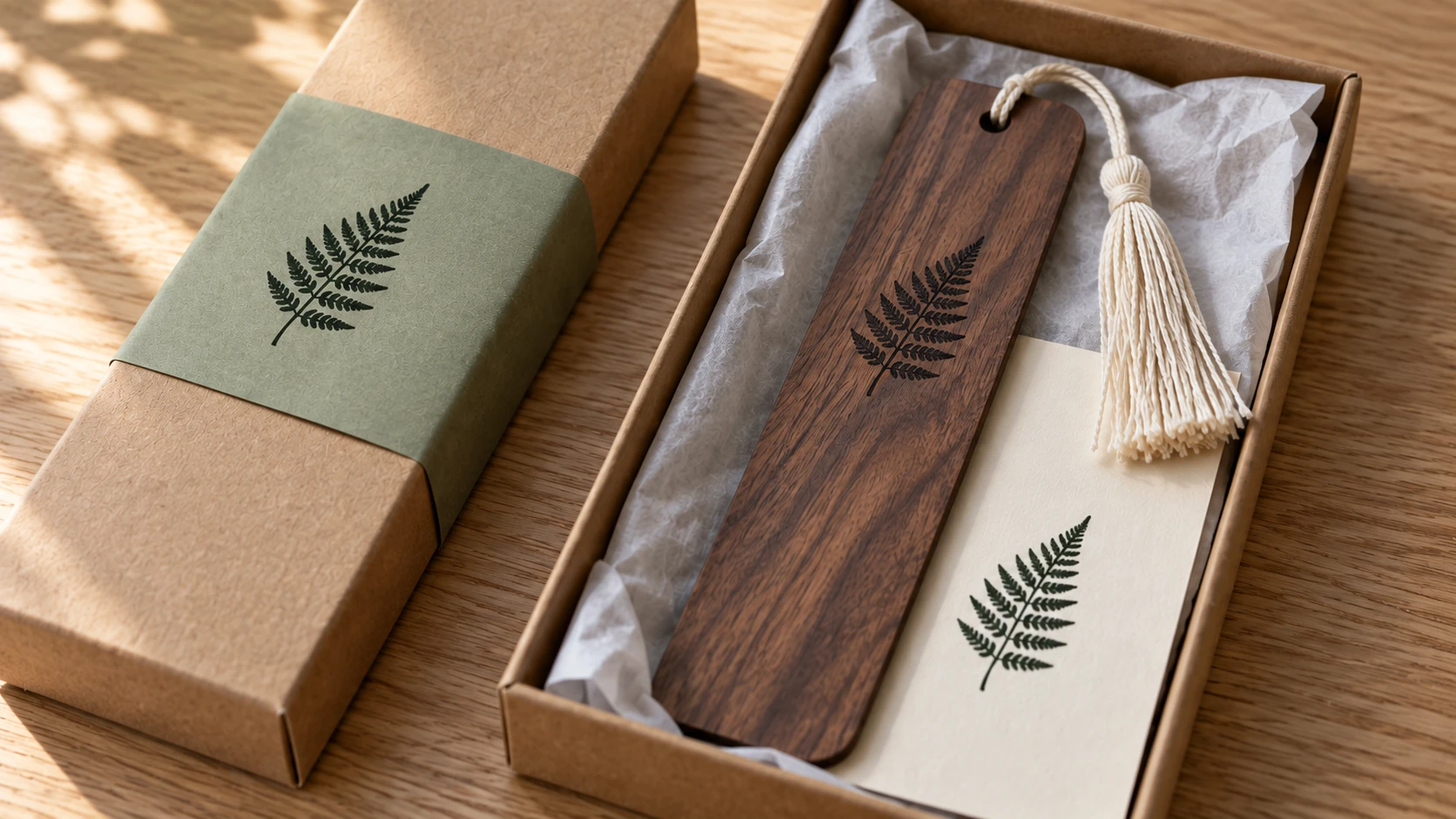
Repeat a recognizable mark across the product and packaging. The paper, wood and photography belong to the same example set.
Telling Your Maker Story
People buy from people. It's cliche because it's true. When someone can choose between an identical product from "Generic Shop #47" and "a woodworker in Vermont who started making cutting boards after retiring from teaching," they choose the story.
What Makes a Good Maker Story
Your story doesn't need to be dramatic. It just needs to be genuine. Here are the elements that resonate with buyers:
How you started. "I bought a laser engraver during lockdown and fell in love with the process." That's relatable. That's human. It makes a customer feel like they're buying from a real person.
What you care about. Do you obsess over material quality? Do you hand-finish every piece? Do you test every product before shipping? Tell people. It builds trust and justifies your pricing.
Why you keep doing it. "I love seeing photos when customers hang my signs in their homes." "Nothing beats the moment when a customer says their mom cried when she opened the gift." These emotional connections turn one-time buyers into repeat customers and brand advocates.
Where to Tell Your Story
- Etsy About section: This is prime real estate that most sellers leave blank or fill with generic text. Use it.
- Social media bio: A one-line version of your story.
- Thank-you cards: A sentence or two about who you are and why you make what you make.
- Craft fair conversations: When someone asks "do you make all of this?" your story is your answer.
- Instagram stories and reels: Behind-the-scenes content showing your process.
The Story Formula
If you're stuck, try this structure:
- What you were doing before (briefly)
- What sparked your maker journey
- What you love about what you do now
- What you promise your customers
Example: "I spent 20 years as a graphic designer before discovering CNC routing. Now I combine my design background with handcrafted woodwork to create signs and home decor that look as good up close as they do from across the room. Every piece is designed, carved, and finished by hand in my Michigan workshop."
That's three sentences. It covers background, personality, quality, and location. It gives a customer a reason to choose you.
Consistency Across Platforms
A brand only works if it's recognizable everywhere your customers encounter it. If your Etsy shop uses one look, your Instagram uses another, and your craft fair booth uses a third, you're building three weak impressions instead of one strong one.
Platform-Specific Considerations
Etsy:
- Shop banner using your brand colors and logo
- Profile photo (your logo or a photo of you in your workshop)
- Consistent listing photo style (see photography section above)
- About section telling your maker story
- Shop policies that reflect your brand voice
Instagram:
- Profile photo matching your Etsy shop
- Bio with your tagline and what you make
- Consistent post style (same filters, same editing, same background colors)
- Stories highlighting your process, workspace, and personality
- Link in bio to your shop or a link-in-bio page
Craft Fairs:
- Tablecloth or display in your brand colors
- Signage with your logo and name
- Business cards with QR code linking to your shop
- Packaging visible on the table (so people see the experience before they buy)
- Consistent pricing display
For in-depth craft fair strategy, including booth setup and sales techniques, check out our craft fair selling guide.
Personal Website (if applicable):
- Same colors, fonts, and logo as everywhere else
- Your maker story prominently displayed
- Links to your Etsy shop and social media
- Portfolio of your best work
The Cross-Platform Audit
Every few months, do a quick audit. Pull up your Etsy shop, your Instagram profile, your business card, and a photo of your craft fair setup. Put them side by side (screenshots on your computer work fine). Ask yourself:
- Do they look like they're from the same business?
- Is my logo/name displayed consistently?
- Are my colors consistent?
- Would a customer recognize this as the same brand across all channels?
If the answer to any of these is "not really," you know where to focus next.
QR Codes: The Bridge Between Physical and Digital
QR codes have quietly become one of the most useful tools in a maker's branding toolkit. They bridge the gap between your physical products and your digital presence. When someone buys your cutting board and sees a QR code on the packaging, they can scan it and instantly find your shop, leave a review, or follow you on social media.
Where to Put QR Codes
- Thank-you cards: Links to your shop or a discount code for next purchase
- Business cards: Links to your Etsy shop or Instagram
- Craft fair signage: Links to your online shop for items not on the table
- Product tags: Links to care instructions, your story, or a review request
- Packaging inserts: Links to a video showing how the product was made
Making QR Codes That Match Your Brand
Most QR code generators give you a generic black-and-white square. That works, but branded QR codes work harder for you. Our QR Code Generator lets you create QR codes that you can download as SVG or PNG files, ready for printing at any size.
For best results, make sure your QR code links to a page that matches your brand. If someone scans a beautifully designed QR code and lands on a messy, unbranded page, the magic is lost.
Tip
Test every QR code before you print 500 business cards. Scan it with your phone, make sure it goes to the right URL, and make sure the landing page looks good on mobile. A broken QR code is worse than no QR code.
Consistent Product Descriptions with ListingLab
One of the most overlooked aspects of branding is your product descriptions. When every listing reads differently, with different formats, different tones, and different levels of detail, your shop feels inconsistent. When every listing follows a consistent structure with a cohesive voice, it reinforces your brand.
Writing consistent product descriptions manually is tedious. You start strong with your first few listings, then start rushing through later ones because you're tired of typing.
ListingLab solves this. Upload a photo of your product and it generates Etsy-optimized titles, descriptions, key features, SEO keywords, and social media posts. The key benefit for branding: it produces consistent, professional descriptions every time, so your entire shop reads like it was written by the same person (because it was, sort of).
How to Use ListingLab for Brand Consistency
- Upload your product photo.
- Review the generated titles and descriptions. Pick the ones that best match your brand voice.
- Make minor adjustments to add your personal touch or specific brand language.
- Copy the SEO keywords and add them to your listing tags.
- Use the social media post copy for Instagram or Facebook when you promote the listing.
The SEO keywords are especially valuable. Good keywords help your listings rank higher in Etsy search, which means more visibility without paying for ads. If you're building a brand, being found in search is as important as looking good when people arrive.
Building a Following vs. Building a Brand
These are not the same thing, and confusing them is one of the most common mistakes makers make.
A following is a number. It's how many people follow you on Instagram, how many Etsy favorites your shop has, how many people are on your email list. A following can be built with giveaways, viral posts, and trending hashtags.
A brand is a perception. It's what people think and feel when they see your name, your products, or your packaging. A brand is built through consistency, quality, and repeated positive experiences over time.
Here's the uncomfortable truth: you can have 10,000 Instagram followers and zero brand recognition. If those followers came from a viral video of your cat walking across your laser bed (it happens), they don't associate your name with quality craft products. They associate it with a funny cat video.
The Right Order
Build the brand first. Then grow the following.
This means:
- Define your niche, name, and visual identity
- Create consistent product photos and descriptions
- Establish your brand presence across platforms
- THEN start growing your audience through content, social media, and advertising
When you grow a following after your brand is established, every new follower is exposed to a cohesive, professional identity. They know what you do, what you stand for, and why they should care.
When you grow a following before your brand is established, you're pouring water into a leaky bucket. People follow you but have no clear reason to remember you, buy from you, or recommend you.
Content That Builds Both
The best content for makers builds brand recognition AND grows your following simultaneously:
- Process videos. Show yourself making a product from start to finish. This builds brand (people associate your face with your craft) and following (process videos perform well on Instagram and TikTok).
- Before/after reveals. Raw material to finished product. These are inherently shareable and showcase your skill.
- Customer spotlights. Share photos of your products in customers' homes (with permission). This builds social proof and emotional connection.
- Behind the scenes. Your workshop, your tools, your material selection process. This humanizes your brand.
- Educational content. Tips, tricks, and how-tos related to your craft. This positions you as an expert and attracts people who are genuinely interested in your niche.
For a deeper look at social media strategy for makers, our guide on social media marketing for makers covers platform-specific tactics and content planning.
Common Branding Mistakes Makers Make
After watching hundreds of maker businesses struggle with branding, the same mistakes keep coming up. Here's what to avoid.
Mistake 1: Changing Everything Too Often
You launch with a rustic look, switch to modern minimalist three months later, then try a vintage aesthetic after that. Every time you change, you reset your brand recognition to zero. Your repeat customers can't find you because your shop looks completely different from when they last visited.
The fix: Commit to one identity for at least a year. It doesn't have to be perfect. Consistent and decent beats perfect and constantly changing.
Mistake 2: Trying to Appeal to Everyone
Your shop sells engraved pet items, custom car parts, baby shower decorations, and corporate awards. There's no through line. No specific customer can look at your shop and say "this is for me."
The fix: Pick a lane. If you truly want to sell across multiple categories, consider separate shops or at least organize your single shop into clearly defined sections.
Mistake 3: Copying Another Maker's Brand
You see a successful shop and think "I'll just do what they're doing." You pick similar colors, similar photos, a similar name. Now you look like a knockoff version of an established brand, which is actually worse than having no brand at all.
The fix: Draw inspiration from brands you admire (maker brands and otherwise), but build something that reflects your own personality, story, and strengths. Originality is more memorable than imitation.
Mistake 4: Investing in the Wrong Things First
Spending $500 on custom packaging before you've sold 50 orders. Buying a professional logo before you've settled on your niche. Building a custom website before you've validated your products on Etsy.
The fix: Start with the free and cheap stuff (name, color palette, font choices, consistent photos, Etsy shop optimization). Invest money in branding only after you've proven that people want to buy what you make.
Mistake 5: Ignoring Your Online Presence
You have a beautiful craft fair setup but your Etsy shop has blurry photos and your Instagram hasn't been updated in four months. Every customer who searches for you after a craft fair encounter finds a digital ghost town.
The fix: Your online presence is your around-the-clock storefront. It needs at least as much attention as your physical presence. Every new product should be photographed consistently and posted across all your platforms.
Mistake 6: No Brand Voice
Your listing descriptions alternate between ultra-formal ("This exquisite, hand-crafted artisanal piece...") and too casual ("hey check out this sick cutting board lol"). There's no consistent personality coming through in your text.
The fix: Write like you talk. If you're friendly and approachable in person, write that way in your descriptions, social media posts, and emails. If you're more measured and detail-oriented, let that show. Just be consistent.
Mistake 7: Forgetting the Post-Purchase Experience
Your branding is on point through the moment someone clicks "buy." Then they receive their order in a crumpled Amazon box with no padding, no thank-you note, and a packing slip that says "order #47291." All that brand equity evaporates.
The fix: The post-purchase experience is the most underrated branding opportunity. A simple thank-you card, branded tissue paper, and secure packaging turn a transaction into an experience.
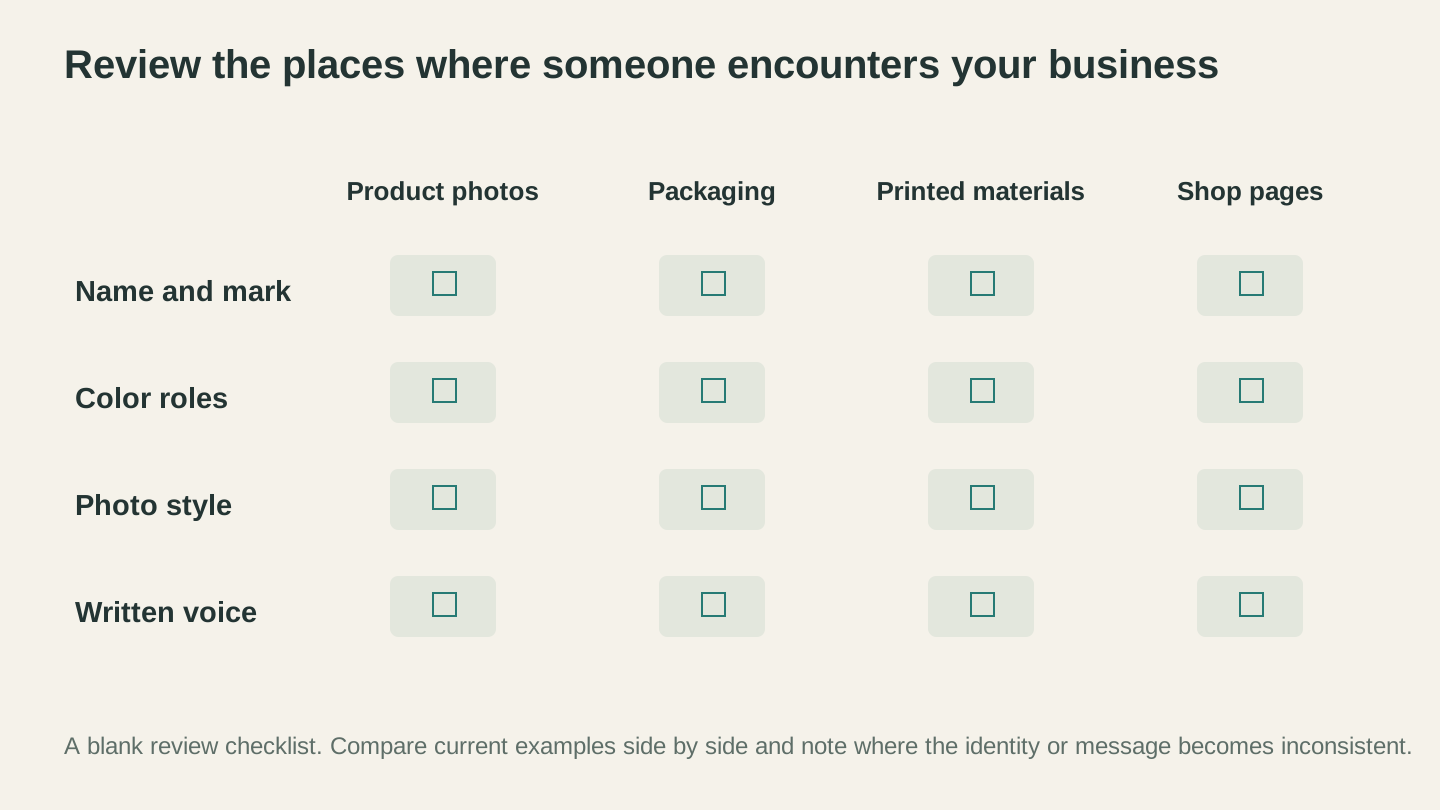
Compare actual examples side by side. Note where the mark, colors, photography or voice feel disconnected, then decide what needs attention.
Your Brand-Building Action Plan
If you've read this far and feel overwhelmed, here's the step-by-step order. Don't try to do everything at once. Move through these stages and give each one your full attention before moving to the next.
Phase 1: Foundation (Week 1-2)
- Define your niche: what you make and who you make it for
- Choose your brand name (check availability on Etsy, Instagram, and as a domain)
- Write your maker story (3-5 sentences)
- Pick your color palette (use a tool like Coolors or Adobe Color)
- Choose your two fonts from Google Fonts
Phase 2: Visual Identity (Week 3-4)
- Create your logo (start with a clean wordmark in your heading font)
- Photograph your products consistently (pick one style and commit)
- Update your Etsy shop banner, profile photo, and About section
- Update your Instagram profile to match
- Design your thank-you card template in your design tool
Phase 3: Consistency and Touchpoints (Month 2)
- Write or rewrite all product descriptions with a consistent voice (use ListingLab for speed and SEO optimization)
- Order your first batch of branded stickers or stamps
- Create a social media post template in your brand colors and fonts
- Generate QR codes for your packaging and business cards with our QR Code Generator
- Print business cards and thank-you cards
Phase 4: Growth (Month 3+)
- Begin posting consistently on social media with branded templates
- Collect and share customer photos (with permission)
- Apply to craft fairs with your cohesive booth setup
- Start building an email list for repeat customers
- Revisit and refine based on what's working
The Brand-Building Toolkit for Makers
| Task | Tool | Cost |
|---|---|---|
| Create QR codes for packaging | QR Code Generator | Free |
| Generate product descriptions | ListingLab | 1 credit (text), 1 credit (photo) |
| Design logos and templates | Online design tool | Free tier available |
| Choose fonts | Google Fonts | Free |
| Create color palettes | Coolors.co | Free |
| Design stickers and labels | Design tool or vector editor | Free |
| Photo editing | Design tool or your phone's editor | Free |
| Manage your Etsy shop | Etsy Seller app | Free (plus Etsy fees) |
What Good Maker Branding Actually Looks Like
Forget the theoretical stuff for a moment. Here's what a well-branded maker business looks like in practice.
A customer discovers you at a craft fair. Your booth has a cohesive look: tablecloth in your brand color, a clean banner with your logo, products displayed consistently. They buy a custom sign and take your business card, which has a QR code linking to your Etsy shop.
That evening, they scan the QR code. They land on your Etsy shop, which looks like an extension of your craft fair booth. Same colors, same logo, same photography style. They recognize it instantly. They favorite your shop and browse a few more items.
A week later, they see your Instagram post in their feed. Same visual style. A process video showing you making a sign similar to the one they bought. They follow you.
A month later, they need a housewarming gift. They don't search Etsy for "custom sign." They go directly to your shop because they remember your name, your look, and their positive experience. They buy again. They tell their friend about your shop.
That's the cycle branding creates. Discovery, recognition, trust, repeat purchase, word of mouth. Every element of your brand, from your name to your packaging, contributes to that cycle.
Without branding, every customer interaction starts from scratch. With branding, each interaction builds on the last.
Start With What You Have
You don't need permission, a marketing degree, or a big budget to brand your maker business. You need a clear niche, a consistent look, a genuine story, and the discipline to apply it everywhere.
The tools are accessible. ListingLab handles your product descriptions and SEO. The QR Code Generator creates codes for your packaging and business cards. A good online design tool and Google Fonts cover your visual design needs. Your smartphone takes great product photos.
The only thing you actually need to invest is intention. The intention to stop treating your shop as a random collection of things you happen to make, and start treating it as a brand that people can recognize, trust, and return to.
Your products are already good. Build a brand that matches.
Related Tools
Ready to try these tools?
Sign up free, no credit card required. Free tools available immediately.
Start Free