Lasergegraveerde en CNC-projecten afwerken: beitsen, schilderen en afdichten
Je hebt een uur besteed aan het nauwkeurig afstellen van je laserinstellingen of aan het perfectioneren van je CNC-toolpaths. De snede was geweldig. En toen smeerde je er polyurethaan op, waardoor het geheel er slechter uitzag dan voordat je begon.
Afwerken is waar goede projecten geweldige projecten worden. Het is ook waar geweldige projecten kunnen worden verpest. Het verschil zit niet in talent. Het gaat erom te weten welke afwerking je moet gebruiken, wanneer je die moet aanbrengen en in welke volgorde je alles moet doen. Veel makers beschouwen afwerken als een bijzaak, en dat zie je.
Deze gids behandelt de volledige workflow voor het afwerken van zowel lasergegraveerde als CNC-gegraveerde projecten. Verf vullen, beitsen, transparante lak, voedselveilige opties en de specifieke schuiertechnieken voor CNC waarmee je gereedschapssporen laat verdwijnen.
Waarom afwerken belangrijker is dan je denkt
Een onafgewerkt houtproject is kwetsbaar. Vocht dringt binnen, het hout werkt, gegraveerde details vervagen en vingerafdrukken van het hanteren laten permanente sporen achter. Een goede afwerking doet drie dingen:
Bescherming. Een afgedicht oppervlak is bestand tegen vocht, uv-schade en dagelijks gebruik. Die snijplank die je hebt gegraveerd? Zonder afwerking zwelt de houtnerf op zodra iemand hem wast, en wordt de gravure vaag.
Contrast. Afwerken kan het uiterlijk van je gravure of snijwerk drastisch veranderen. Beits trekt anders in laserbrandsporen dan in het omliggende hout. Verf vullen laat gegraveerde tekst opvallen vanaf de andere kant van de kamer. Zelfs transparante lak maakt het hout iets donkerder en laat de nerf tot leven komen.
Professionaliteit. Als je op Etsy verkoopt, is de kwaliteit van de afwerking wat een artikel van $15 onderscheidt van een artikel van $45. Kopers merken het. Een prachtig gegraveerd bord met druipers in de transparante lak ziet eruit als een mislukking van een hobbymarkt. Een netjes afgewerkt werkstuk ziet eruit alsof het uit een professionele werkplaats komt.
PRINT. SNIJD. GRAVEER.
- Meerdere indelingen (SVG, DXF, PNG)
- Door machines geteste ontwerpen
- Commerciële licenties
Gesponsord door PrintCutCarve.com
Lasergravures met verf vullen
Verf vullen is de techniek waarmee gegraveerde tekst en ontwerpen echt opvallen. Je graveert in het hout, vult de gegraveerde delen met verf en verwijdert vervolgens het overtollige verf van het oppervlak. De verf blijft alleen in de verzonken gegraveerde delen zitten.
Dit is de meest voorkomende afwerkingsvraag van makers die met lasers werken, en de methode met afplaktape is de schoonste manier om het te doen.
De methode met eerst afplakken (beste resultaten)
Dit is de aanpak die professionele resultaten oplevert. Plak af vóór het graveren, niet erna.
Stap 1: Breng transferfolie of afplaktape aan. Bedek het volledige oppervlak van je werkstuk met transferfolie (het soort dat voor vinyl wordt gebruikt). Druk het stevig aan met een rakel of creditcard. Geen luchtbellen, geen opstaande randen. De tape werkt als een sjabloon.
Stap 2: Graveer door de tape heen. Voer je laseropdracht uit zoals gewoonlijk. De laser brandt door de tape heen en in het hout eronder. Je hebt nu perfect afgeplakte randen rond elk gegraveerd deel.
Stap 3: Breng verf aan. Gebruik acrylverf en een schuimkwast of kleine roller. Dep verf in de gegraveerde delen. Wees niet te voorzichtig. Je kunt royaal zijn, omdat de tape alles beschermt wat niet gegraveerd is. Twee dunne lagen zijn beter dan één dikke laag. Laat elke laag 15 tot 20 minuten drogen.
Stap 4: Verwijder de tape. Zodra de verf droog aanvoelt, trek je de transferfolie langzaam los. Trek onder een lage hoek (bijna parallel aan het oppervlak) voor strakke randen. Als je te lang wacht en de verf volledig uithardt, kan die verf uit de gravures worden getrokken. Wacht niet tot de volgende ochtend.
Stap 5: Werk bij. Gebruik een vochtig wattenstaafje om verf te verwijderen die onder de randen van de tape is doorgelopen. Een beetje uitlopen gebeurt. Met een lichte aanraking met fijn schuurpapier (korrel 400) op het oppervlak verwijder je achtergebleven resten zonder de gravure te beschadigen.
Tip
Gebruik voor donker hout zoals walnoot witte of goudkleurige acrylverf. Op licht hout zoals esdoorn zorgt zwarte of donkerblauwe verf voor het sterkste contrast. Metallic goud- en zilververf werken ook goed voor een hoogwaardige uitstraling.
De afveegmethode (sneller, minder schoon)
Als je geen transferfolie hebt of werkt aan een werkstuk dat al gegraveerd is, kun je achteraf verf vullen.
Breng verf met een schuimkwast aan over het gegraveerde deel en zorg er bewust voor dat er ook verf op het omliggende oppervlak komt. Wacht 30 tot 60 seconden (niet langer) en veeg het oppervlak schoon met een licht vochtige doek. De verf blijft in de verzonken gegraveerde delen zitten en wordt van het vlakke oppervlak geveegd.
Dit werkt het best op glad hout met een dichte nerf, zoals esdoorn of kersenhout, waar het oppervlak de verf niet snel opneemt. Bij hout met een open nerf, zoals eik, trekt de verf in de nerf aan het oppervlak en krijg je die nooit helemaal schoon.
Verfsoorten die werken
Acrylverf is de standaard. Het is goedkoop, droogt snel, is verkrijgbaar in elke kleur en maak je schoon met water. Dit gebruiken de meeste lasermakers.
Emailleverf geeft een hardere, duurzamere vulling, maar droogt langzamer en vereist terpentine voor het schoonmaken. De moeite waard voor artikelen die intensief worden gebruikt.
Verfstiften werken voor kleine details en bijwerken. Het merk Posca is populair. Niet praktisch voor grote gegraveerde oppervlakken.
Spuitverf is te dun voor het vullen van gravures. Het hoopt zich ongelijkmatig op en bouwt niet genoeg op in de verzonken delen. Gebruik het niet voor verf vullen.
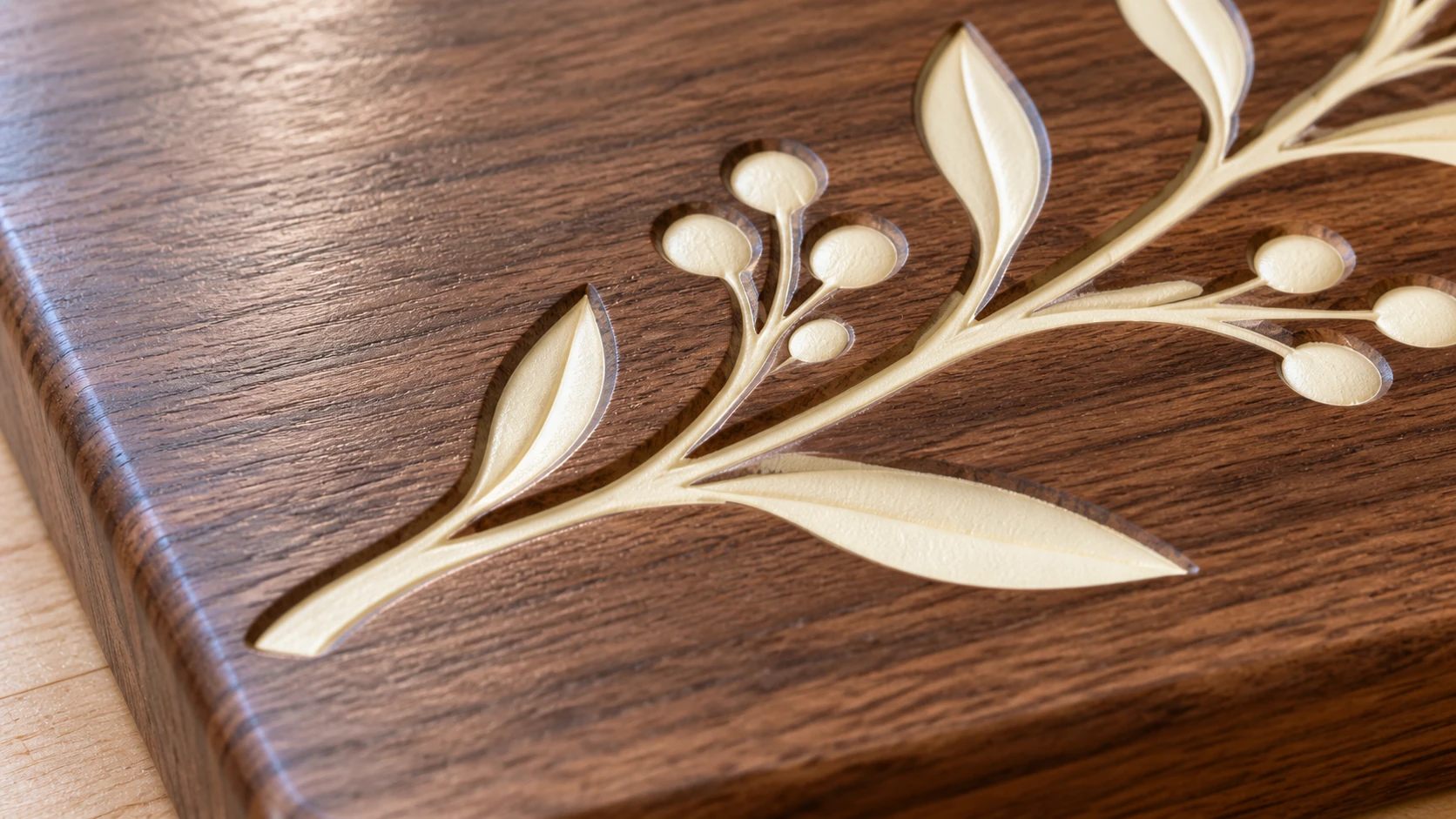
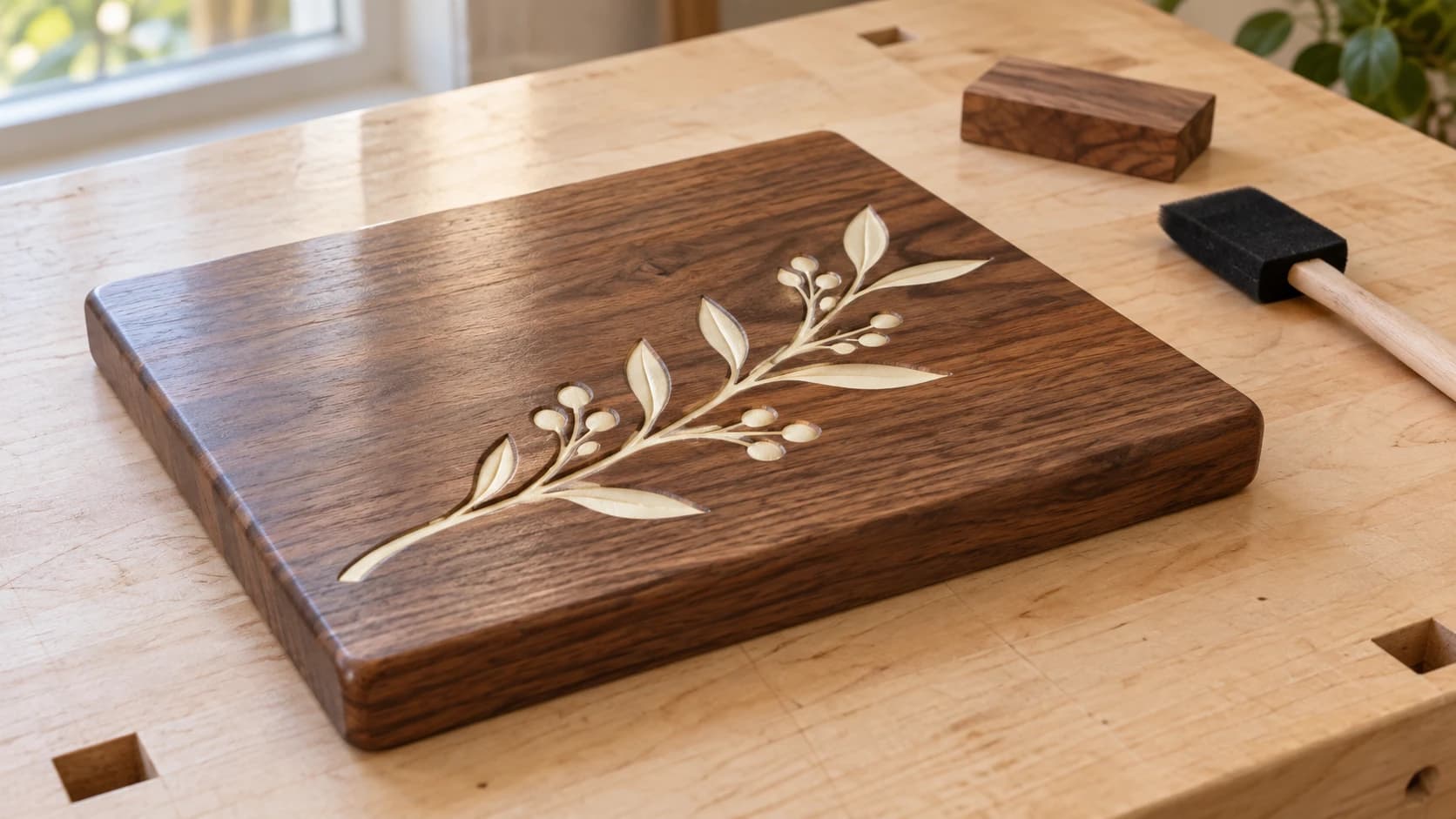
Een close-up van dezelfde plaquette laat zien dat de verf onder het oppervlak van het walnotenhout blijft, met strakke grenzen rond de gegraveerde tak.
Laser-gegraveerd hout beitsen
Lasergravures beitsen is lastiger dan verf vullen, omdat de beits anders reageert op verbrand hout dan op onverbrand hout. Inzicht in deze wisselwerking is de sleutel tot resultaten waar je tevreden mee bent.
Hoe beits reageert op laserbrandsporen
Wanneer een laser hout graveert, verkoolt hij het oppervlak. Dat verkoolde hout is al donker en de poriën zijn door de hitte in feite afgedicht. Wanneer je er beits over aanbrengt:
- Onverbrand hout neemt de beits op. Het wordt donkerder en neemt de kleur van de beits aan.
- Verbrande/gegraveerde delen weren de beits af. De verkoling werkt als een natuurlijke sealer. De beits blijft even op het oppervlak liggen en veeg je daarna weg.
Het resultaat? Je gegraveerde delen blijven donker (door de verkoling) en je ongegraveerde delen worden donker (door de beits). Het contrast tussen gegraveerde en ongegraveerde delen neemt af. Op licht hout zoals esdoorn kan de gravure hierdoor bijna verdwijnen.
Wanneer beitsen goed werkt
Beitsen werkt het best in twee situaties:
Donkere beits op licht hout met een diepe gravure. Als je gravure diep genoeg is zodat de beits zich in het verzonken deel verzamelt en het donkerder maakt, krijg je een reliëfachtig uiterlijk. De diepte creëert schaduw en de beitskleur op het omliggende hout zorgt voor een uniforme tint.
Lichte beitswassingen. Verdunde beits (één deel beits, twee tot drie delen terpentine voor oliegedragen beits, of water voor watergedragen beits) voegt subtiele kleur toe zonder het contrast van de gravure te overheersen. Dit werkt goed voor werkstukken waarbij je licht hout warmer wilt maken zonder het laserwerk te verbergen.
Tips voor beitsen
Test altijd eerst op een reststuk. Graveer een proefstuk van dezelfde houtsoort en beits het. Wat er geweldig uitziet op grenen ziet er op populier volledig anders uit. Vijf minuten testen bespaart uren spijt.
Breng uiteraard beits aan vóór de transparante lak. Maar denk ook hieraan: overweeg de beits vóór het graveren aan te brengen bij houtsoorten waarbij je maximaal contrast wilt. De laser brandt door het gebeitste oppervlak heen en onthult lichter hout eronder, waardoor je lichte gravures op een donkere achtergrond krijgt.
Gelbeits is beter controleerbaar dan vloeibare beits. De gel blijft langer op het oppervlak liggen voordat hij intrekt, waardoor je tijd hebt om hem in (of juist weg van) specifieke delen te werken. Hij loopt ook niet in gegraveerde kanalen zoals dunne vloeibare beits.
Waarschuwing
Oliegedragen beitsen hebben 24 tot 48 uur nodig om volledig uit te harden voordat je transparante lak aanbrengt. Als je te vroeg afwerkt, blijven de oplosmiddelen eronder opgesloten en blijft de afwerking kleverig of ontstaan er troebele vlekken. Watergedragen beitsen drogen sneller (2 tot 4 uur), maar doen de nerf opstaan. Daarom moet je vóór het lakken licht schuren met korrel 320.
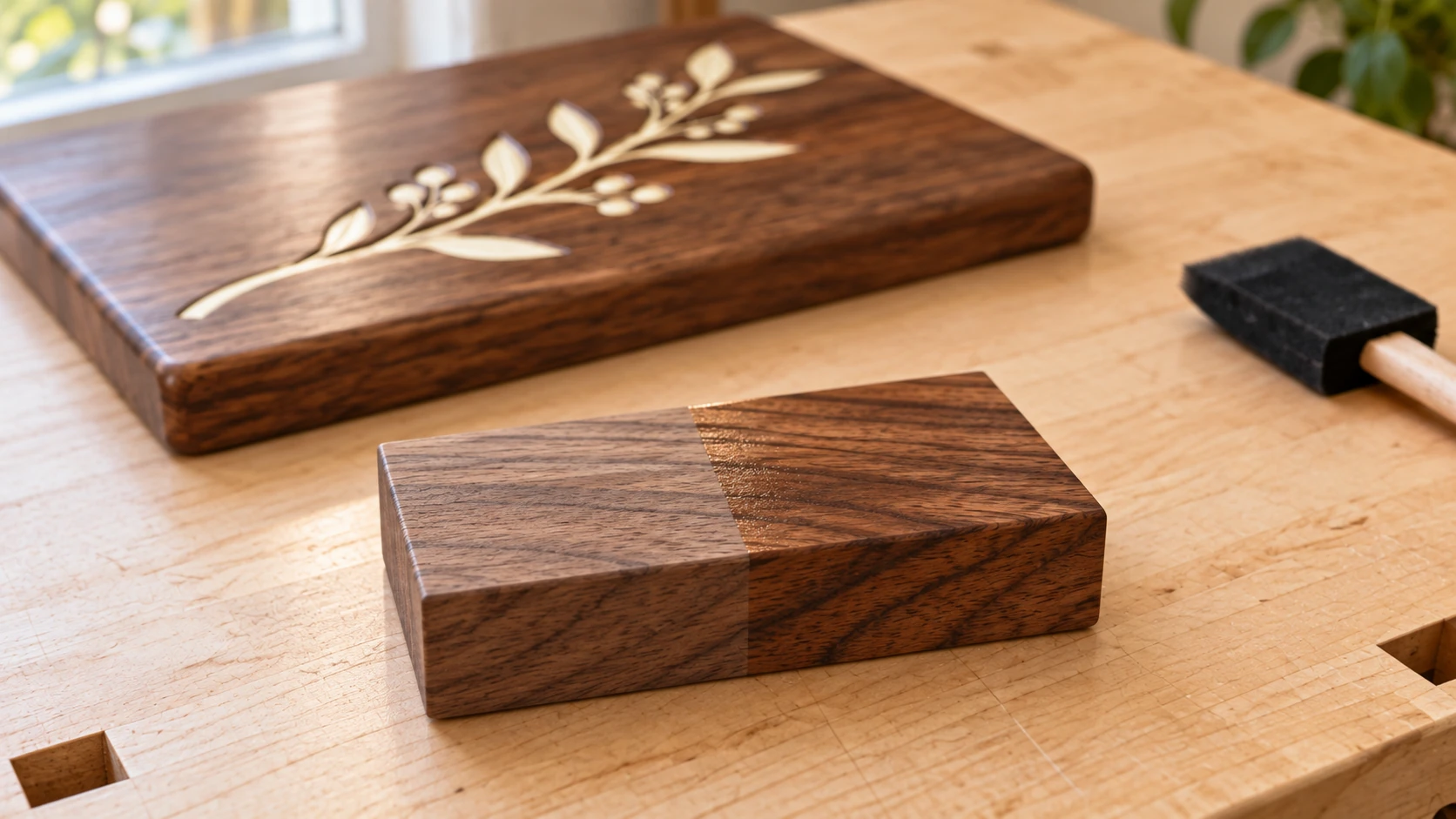
Met een afzonderlijk teststuk kun je het uiterlijk van onbehandeld en afgewerkt hout vergelijken voordat je de plaquette afwerkt. De getoonde verandering is illustratief; test je eigen afwerking en houtvoorraad.
Opties voor transparante lak
Elk afgewerkt project heeft een soort sealer nodig. Zelfs als je niet beitst of verf vult, beschermt transparante lak het hout en laat die de nerf opvallen. Dit zijn de belangrijkste opties, gerangschikt op wat het best werkt voor typische laser- en CNC-projecten.
Oliegedragen polyurethaan
De alleskunner voor borden, plaquettes en decoratieve artikelen. Oliegedragen polyurethaan geeft het hout een warme amberkleurige tint, die er geweldig uitziet op esdoorn en kersenhout. Verkrijgbaar in zijdeglans, halfglans en hoogglans.
Voordelen: sterk, vloeit vanzelf uit, warme tint, overal verkrijgbaar.
Nadelen: lange droogtijd (4 tot 6 uur tussen lagen). Wordt na verloop van tijd iets geel. Ruikt vreselijk. Schoonmaken met terpentine.
Aanbrengen met: een kwast met natuurhaar voor vlakke oppervlakken, of wipe-on polyurethaan voor gegraveerde oppervlakken. Wipe-on is beter voor laserwerk, omdat het zich niet ophoopt in gravures. Twee tot drie lagen, met tussendoor schuren met korrel 320.
Watergedragen polyurethaan
Biedt dezelfde bescherming als de oliegedragen variant, maar droogt kristalhelder zonder warme amberkleur. Goed als je wilt dat het hout zijn natuurlijke kleur grotendeels behoudt.
Voordelen: snel droog (1 tot 2 uur tussen lagen). Helder. Weinig geur. Schoonmaken met water.
Nadelen: doet de nerf bij de eerste laag opstaan (schuur daarna met korrel 320). Dunner per laag, dus plan drie tot vier lagen. Minder duurzaam dan oliegedragen polyurethaan op oppervlakken die veel slijten.
Aanbrengen met: een kwast met synthetische haren of een schuimkwast. Gebruik nooit natuurhaar bij watergedragen afwerkingen.
Spuitlak
De snelste afwerkingsoptie. Spuitlak uit een spuitbus droogt binnen enkele minuten, bouwt snel op en geeft een glad, professioneel oppervlak. Veel lasermakers gebruiken dit voor borden en decoratieve werkstukken, omdat het snel gaat en er geweldig uitziet.
Voordelen: droogt binnen enkele minuten. Meerdere lagen in een uur. Zeer gladde afwerking. Geen kwaststrepen.
Nadelen: dun per laag, dus minimaal 3 tot 4 lagen. Aanbrengen in een goed geventileerde ruimte (de dampen zijn sterk). Kan bij hoge luchtvochtigheid wit uitslaan.
Aanbrengen met: lichte, gelijkmatige bewegingen vanaf 8 tot 10 inch afstand. Houd de bus in beweging. Meerdere dunne lagen, geen enkele dikke laag.
Tip
Spuitlak is de beste keuze voor werkstukken met fijne gegraveerde details. De lak wordt dun genoeg aangebracht om de textuur van de gravure niet op te vullen en droogt zo snel dat hij geen tijd heeft om zich in verzonken delen op te hopen.
Epoxyhars
Een dikke, zelfnivellerende coating die een glasglad oppervlak met hoge glans oplevert. Wordt ook gebruikt om gegraveerde delen te vullen met transparante of gekleurde hars.
Voordelen: extreem duurzaam. Waterdicht. Kan worden gekleurd met pigmenten of micapoeder.
Nadelen: duur. Moet nauwkeurig uit twee delen worden gemengd. Beperkte verwerkingstijd (20 tot 40 minuten). Bellen blijven achter zonder een behandeling met een heteluchtpistool. Moeilijk te repareren bij krassen.
Het best voor: onderzetters, serveerschalen en wandkunst waarbij een dikke glanzende afwerking gewenst is.
Tungolie en Deense olie
Doordringende olieafwerkingen die in het hout trekken in plaats van erop te blijven liggen. Ze versterken de nerf prachtig en voelen natuurlijk aan. Minder bescherming dan polyurethaan of lak, maar het uiterlijk is dat vaak waard.
Voordelen: aanbrengen, wachten, afvegen. Laat de nerf als niets anders naar voren komen. Herstelbaar (voeg gewoon meer olie toe).
Nadelen: minimale weerstand tegen water en slijtage. Moet na verloop van tijd opnieuw worden aangebracht. Drie tot vijf lagen voor tungolie, twee tot drie voor Deense olie.
Het best voor: juwelendoosjes, displaystukken en decoratief snijwerk.
Voedselveilige afwerkingen
Als je snijplanken, serveerplanken, keukengerei of iets anders maakt dat met voedsel in aanraking komt, heb je een voedselveilige afwerking nodig. Dit is het meest overgecompliceerde onderwerp in houtbewerking, dus laten we het verduidelijken.
De waarheid over "voedselveilig"
Dit realiseren de meeste mensen zich niet: bijna elke afwerking is voedselveilig zodra die volledig is uitgehard. Oliegedragen polyurethaan, lak, zelfs epoxy. Zodra oplosmiddelen zijn verdampt en de afwerking hard is geworden, is de resterende film inert.
Maar er is een praktisch verschil tussen "technisch veilig na uitharding" en "ontworpen voor contact met voedsel". Op snijplanken komen mesinsnijdingen. Die sneden gaan door een filmlaag heen, en polyurethaan of lak barst en schilfert daarin. Niet erg smakelijk.
Voor snijplanken en voorwerpen waarop wordt gesneden wil je een doordringende afwerking die in het hout trekt, geen film die erop blijft liggen.
De beste afwerkingen voor contact met voedsel
Minerale olie. Minerale olie van voedingskwaliteit is de standaardafwerking voor snijplanken. Het is goedkoop, volledig voedselveilig en gemakkelijk aan te brengen. Wrijf het erop, laat het 20 minuten intrekken en veeg het overtollige weg. Het nadeel: bij regelmatig gebruik moet je het om de paar weken opnieuw aanbrengen. Het slijt weg.
Mengsel van bijenwas en minerale olie (vaak verkocht als "board butter" of "snijplankconditioner"). De bijenwas voegt wat waterbestendigheid en een gladder gevoel toe. Dezelfde toepassing als pure minerale olie. Iets duurzamer. Dit bevelen de meeste makers van snijplanken aan.
Walnootolie. Een drogende olie die na verloop van tijd hard wordt, in tegenstelling tot minerale olie, die vloeibaar blijft. Duurzamer dan minerale olie. Belangrijke veiligheidsopmerking: mensen met een allergie voor noten kunnen reageren op afwerkingen met walnootolie. Vermeld altijd dat je walnootolie hebt gebruikt, vooral als je het artikel verkoopt.
Slagersblokolie. Commerciële producten die speciaal zijn samengesteld voor houten oppervlakken die met voedsel in contact komen. Meestal een mengsel van minerale olie en andere voedselveilige ingrediënten. Volg de aanwijzingen van de fabrikant.
Waarschuwing
Gebruik geen lijnzaadolie (rauw of gekookt) op snijplanken. Rauwe lijnzaadolie doet er eindeloos over om uit te harden en wordt ranzig. Gekookte lijnzaadolie bevat metalen droogmiddelen (kobalt, mangaan) die niet voedselveilig zijn. Ondanks wat sommige houtbewerkers online beweren, is gekookte lijnzaadolie niet geschikt voor oppervlakken die met voedsel in contact komen.
Laser-gegraveerde snijplanken afwerken
Als je een naam of ontwerp in een snijplank hebt gegraveerd, verloopt het afwerkingsproces als volgt:
- Schuur de hele plank met korrel 220 (als dat na het graveren nodig is).
- Blaas stof uit de gravure met perslucht.
- Breng royaal minerale olie of board butter aan. Werk het met een doek in de gegraveerde delen.
- Laat het 20 tot 30 minuten intrekken.
- Veeg al het overtollige weg. De plank moet glad aanvoelen, niet vettig.
- Herhaal het aanbrengen van de olie in de daaropvolgende 24 uur nog 2 tot 3 keer voor maximale verzadiging.
Breng geen polyurethaan, lak of andere filmafwerking aan op een snijplank die voor voedselbereiding wordt gebruikt. Het ziet er aanvankelijk mooi uit, maar schilfert af door het gebruik van messen.
Voor planken die alleen decoratief zijn (aan de muur, nooit voor voedsel gebruikt), kun je elke gewenste afwerking gebruiken. Spuitlak geeft een prachtig resultaat op gegraveerde esdoorn planken die als decoratie dienen.
Specifieke afwerkingstechnieken voor CNC
CNC-projecten hebben afwerkingsproblemen die laserprojecten niet hebben. Gereedschapssporen, pluizige nerf, uitscheuren en ribbels door de stap-over van kogelfrezen moeten allemaal worden aangepakt voordat je naar de beits of het polyurethaan grijpt.
Als CNC-werk nieuw voor je is, behandelt onze beginnersgids voor CNC-frezen de basisprincipes.
Gereedschapssporen wegschuren
Elke CNC-bewerking laat gereedschapssporen achter. Vlakke pockets hebben kleine ribbels door het stap-overpatroon. 3D-snijwerk heeft schulpmarkeringen door kogelfrezen. Profielen hebben soms trillingssporen. Het is jouw taak om deze te verwijderen zonder de details van het snijwerk kwijt te raken.
Geleidelijk fijnere korrels zijn onmisbaar. Begin met korrel 120 om de ribbels en gereedschapssporen weg te nemen. Ga naar 150, vervolgens 180 en daarna 220. Elke korrel verwijdert de krassen van de vorige. Korrelgroottes overslaan betekent dat je de krassen van een grovere korrel alleen oppoetst in plaats van ze te verwijderen.
Gebruik voor vlakke oppervlakken een excenterschuurmachine. Die is sneller en gelijkmatiger dan met de hand schuren. Druk niet hard. Laat de schuurmachine het werk doen. Hard drukken veroorzaakt uitgeholde plekken.
Schuur voor gesneden oppervlakken en binnenhoeken met de nerf mee met de hand. Vouw schuurpapier rond een deuvel of potlood voor krappe rondingen. Schuimschuurblokken volgen contouren beter dan harde blokken.
Gebruik voor 3D-snijwerk (zoals reliëfs van ReliefMaker) een fijne kogelneusfrees met een zeer kleine stap-over (0.5mm tot 1mm) voor de nabewerkingspassage in je CAM-software. Dit beperkt schulpmarkeringen en vermindert het schuurwerk drastisch. Een extra 20 minuten aan de nabewerkingspassage bespaart een uur handmatig schuren.
Omgaan met een pluizige nerf
Sommige houtsoorten (kersenhout, zacht esdoorn en vooral MDF) ontwikkelen tijdens CNC-frezen een pluizige, opstaande nerf. De frees scheurt de houtvezels in plaats van ze netjes te snijden, waardoor een ruwe, pluizige textuur achterblijft.
Verhelp een pluizige nerf met een truc waarbij je de nerf laat opstaan. Vernevel het oppervlak licht met water uit een plantenspuit. Laat het volledig drogen. De opstaande vezels worden tijdens het drogen stugger. Schuur ze weg met korrel 220. Het oppervlak wordt veel gladder, omdat je de vezels hebt verwijderd die later zouden opstaan (bijvoorbeeld wanneer je een watergedragen afwerking aanbrengt).
Doe dit voordat je een afwerking aanbrengt. Als je deze stap overslaat en watergedragen beits of polyurethaan gebruikt, doet de eerste laag de nerf opstaan en voelt je afwerking als schuurpapier.
Uitscheuren en kieren vullen
CNC-frezen kunnen stukken hout lostrekken, vooral in kopshout, noesten en rond scherpe hoeken. Kleine beschadigingen kunnen vóór het afwerken worden gevuld.
Houtvuller (voorgemengde pasta) werkt voor kleine holtes. Stem de kleur af op je hout voor transparante afwerkingen. Als je het werkstuk schildert, is elke houtvuller geschikt.
CA-lijm en zaagsel zorgen voor een onzichtbare reparatie. Vul de holte met zaagsel van dezelfde houtsoort en laat er dunne CA-lijm op druppelen. Het hardt binnen enkele seconden uit. Schuur het vlak. Onder een transparante lak verdwijnt de reparatie bijna volledig.
Epoxyvuller is het best voor grotere holtes. Kleur hem met pigment zodat hij aansluit, of gebruik contrasterende kleuren voor een decoratief effect. Turquoise epoxy in houtscheuren is inmiddels een eigen stijl geworden.
Tip
Bewaar het zaagsel van je CNC-schuurwerk om reparaties te vullen. Houd een klein bakje stof bij van elke houtsoort waarmee je werkt. Kersenstof vult beschadigingen in kersenhout onzichtbaar. Generieke houtvuller past nooit helemaal goed.
Veelgemaakte fouten bij het afwerken
Elke maker maakt deze fouten minstens één keer. Leer van ons collectieve lijden.
1. Het oppervlak niet eerst schoonmaken
Zaagsel, vet van vingers en lijmresten van tape voorkomen allemaal dat de afwerking goed hecht. Veeg het oppervlak vóór elke afwerking af met een kleefdoek. Blaas bij laserprojecten eerst de gegraveerde kanalen schoon met perslucht. Achtergebleven as van het branden vermengt zich met je afwerking en veroorzaakt modderige plekken.
2. De afwerking te dik aanbrengen
Meer is niet beter. Dikke lagen gaan bobbelen, druipen en doen er dagen over om te drogen. Een dikke verflaag pelt uit gravures. Een dikke laag beits wordt vlekkerig.
De regel is eenvoudig: dunne lagen. Altijd. Bouw de dekking op met meerdere dunne lagen in plaats van één zware laag.
3. Tussen de lagen door schuren overslaan
Elke laag polyurethaan of lak neemt stofdeeltjes en kleine luchtbelletjes op. Licht schuren met korrel 320 tussen de lagen haalt deze oneffenheden weg, zodat de volgende laag glad wordt aangebracht. Sla je dit over, dan blijft je afwerking korrelig aanvoelen, hoeveel lagen je ook aanbrengt.
Schuur de laatste laag niet. Schuur tussen de lagen en laat de eindlaag daarna ongestoord uitharden.
4. Afwerken in een stoffige werkplaats
Je hebt net 20 minuten geschuurd en er hangt een stofwolk in de lucht. Nu breng je nat polyurethaan aan. Elk zwevend stofdeeltje landt in je afwerking en blijft er permanent in vastzitten.
Maak je werkplek schoon voordat je gaat afwerken. Veeg, stofzuig en wacht 15 minuten tot het stof is neergedaald. Een klaptafel in de garage met de deur dicht werkt als een speciale afwerkingsplek.
5. De verkeerde afwerking voor de toepassing gebruiken
Oliegedragen polyurethaan op een snijplank. Dikke epoxy over fijne laserdetails. Watergedragen beits op eik zonder conditioner. Stem de afwerking af op het project.
Snelle referentie:
| Projecttype | Beste afwerking |
|---|---|
| Decoratief bord | Spuitlak of wipe-on polyurethaan |
| Snijplank | Minerale olie + bijenwas |
| Onderzetters | Epoxyhars of oliegedragen polyurethaan |
| Gedetailleerde lasergravure | Spuitlak (dunne lagen) |
| 3D-CNC-snijwerk | Tungolie of Deense olie |
| Buitenbord | Spar-urethaan (uv-bestendig) |
| Geschilderd werkstuk | Watergedragen polyurethaan met kwast |
| Meerkleurige inlay | Wipe-on oliegedragen polyurethaan |
6. Beitsen zonder te testen
Elke combinatie van houtsoort, beitskleur en beitstype levert een ander resultaat op. Populier wordt groen met bepaalde beitsen. Zacht esdoorn wordt vlekkerig zonder conditioner. Grenen neemt beits ongelijkmatig op langs de nerf.
Zaag een reststuk van hetzelfde hout. Graveer of snijd er een testpatroon in. Breng je gekozen beits aan. Nu weet je precies hoe het afgewerkte werkstuk eruit zal zien. Dit kost vijf minuten en voorkomt het zinkende gevoel wanneer je ziet hoe een duur stuk walnoot de verkeerde kleur krijgt.
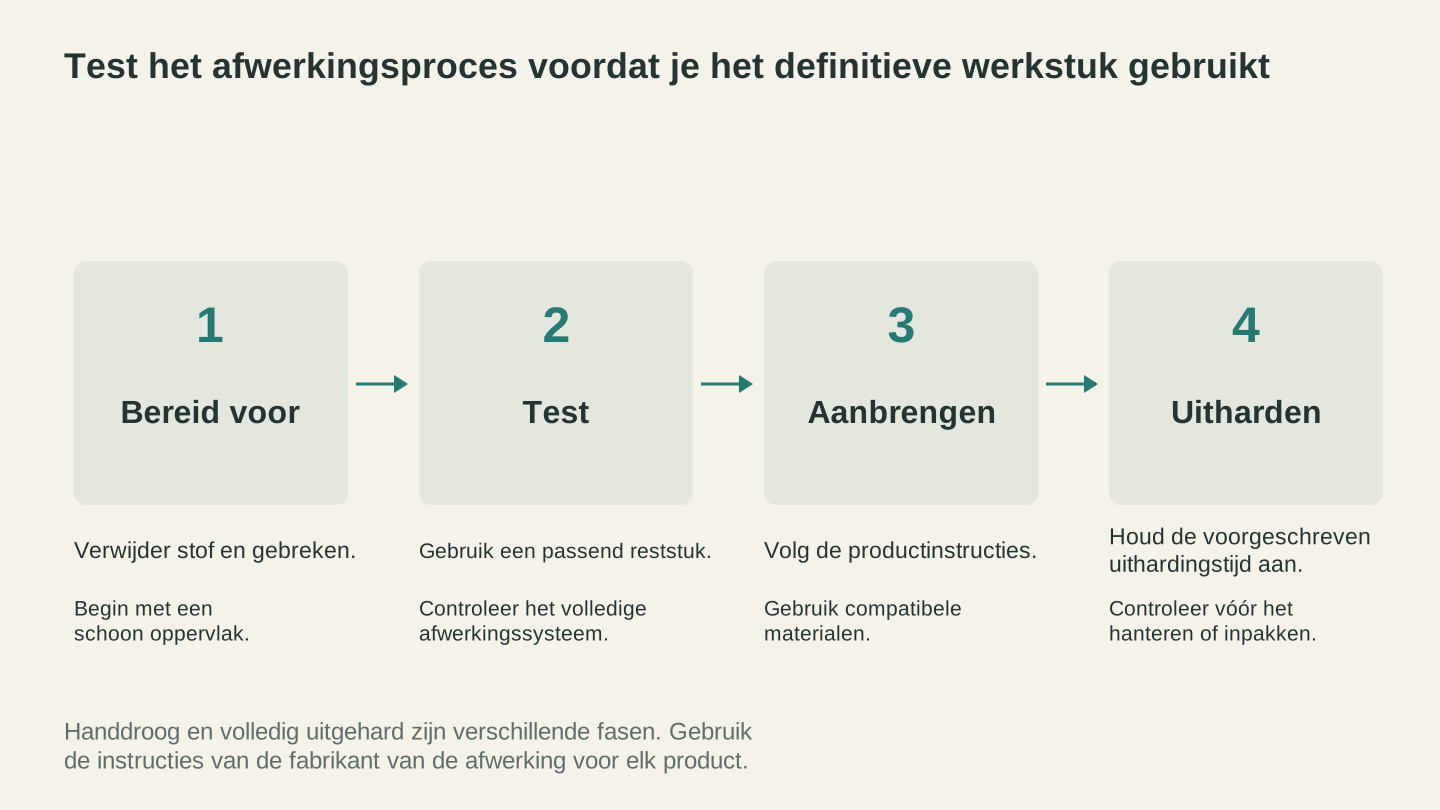
Bereid het oppervlak voor, test de volledige combinatie op een teststuk en breng de afwerking vervolgens aan en laat deze uitharden volgens de instructies van de fabrikant.
Alles samenbrengen
De afwerkingsworkflow is voorspelbaar zodra je hem kent:
- Schuur (CNC-projecten) of maak schoon (laserprojecten). Verwijder gereedschapssporen, blaas stof weg en veeg af met een kleefdoek.
- Beits indien gewenst. Test eerst. Laat volledig drogen en uitharden.
- Vul met verf indien gewenst. Gebruik voor de beste resultaten de methode afplakken-graveren-schilderen-losmaken.
- Dicht af met de juiste transparante lak. Dunne lagen, met tussendoor schuren.
- Laat de eindlaag uitharden. Laat het werkstuk 24 tot 48 uur liggen voordat je het hanteert of verpakt.
De grootste verbetering die je aan je afgewerkte projecten kunt aanbrengen, is niet een betere laser of een luxere CNC kopen. Het is 30 minuten extra besteden aan de afwerking. Een goede afwerking maakt van een weekendproject iets wat mensen willen kopen. Dat is wat hobbyisten die op Reddit posten onderscheidt van makers die op Etsy verkopen.
Neem de tijd. Test op een reststuk. Breng dunne lagen aan. En gebruik in vredesnaam geen gekookte lijnzaadolie voor je snijplanken.
Klaar om deze tools uit te proberen?
Meld je gratis aan, zonder creditcard. Gratis tools zijn direct beschikbaar.
Gratis beginnen