

Shipping Handmade Products Without Losing Money
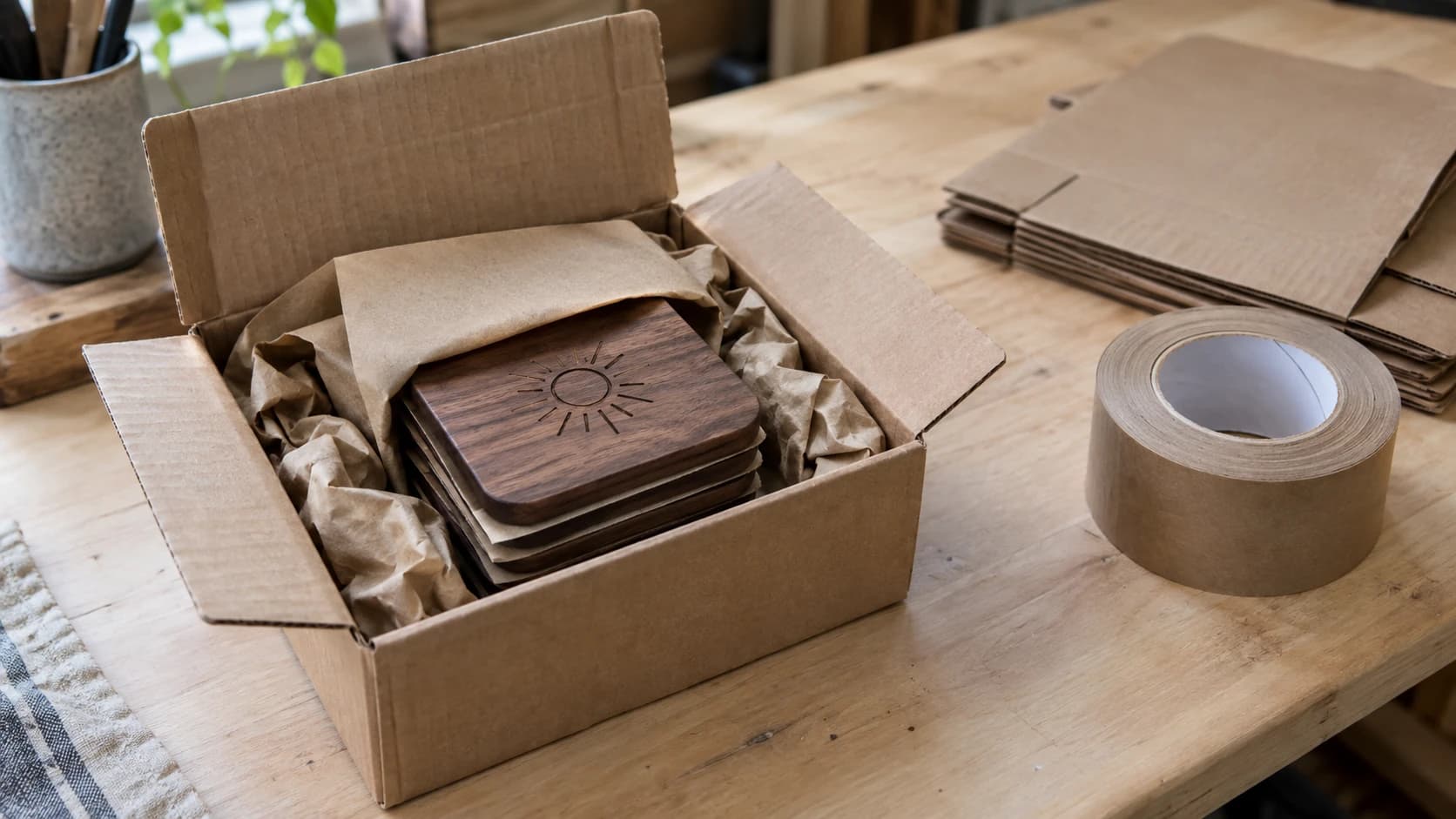
You priced the product carefully. Materials, machine time, your labor, a real margin. Then the order comes in, you go to print the label, and the shipping quote is higher than you guessed. The box costs money too. So does the tape, the cushioning, and the twenty minutes you spent packing it. None of that was in the price.
Shipping is the profit leak almost nobody budgets. It hides because it happens after the sale, when the money already feels earned. This post is the plumbing repair: what packing actually costs, why box size matters more than weight, whether to bake shipping into the price, and where insurance and customs forms fit in. No invented rates anywhere, because rates change constantly and your carrier's calculator knows them better than any blog post does.
Where the Money Actually Leaks
Add up what one shipped order really costs and the label is usually only part of it:
| Cost | Why it gets missed |
|---|---|
| The label | The only one people expect, and still often guessed low |
| The box and mailer | Bought in bulk months ago, so it feels free per order |
| Cushioning and tape | Pennies each, until you multiply by every order |
| Your packing time | Twenty unpaid minutes per order is a part-time job at volume |
| Damaged replacements | One broken piece can erase the profit of several orders |
| The "small" upgrades | Sturdier box, prettier tissue, thank-you card, sticker |
None of these is a reason not to ship. They are a reason to know your real number. Pack one typical order, time it, and total every material that went in the box. That figure, not the label price, is your shipping cost, and it belongs in your pricing math the same way material cost does. Our pricing guide walks through where overhead like this lives in a price.
PRINT. CUT. CARVE.

- Multiple formats (SVG, DXF, PNG)
- Machine-tested designs
- Commercial licenses
Sponsored by PrintCutCarve.com
Package by Fragility Tier, Not by Habit
Most makers pick one packing style and use it for everything. That either overspends on things that cannot break or underprotects things that can. Sort your products into three tiers and give each tier its own standard pack.
| Tier | Examples | What it needs |
|---|---|---|
| Soft and durable | Sewn goods, leather, vinyl decals, printed flexible parts | A rigid mailer or thin box. Protection from bending and moisture, not impact |
| Rigid but tough | Wood signs, acrylic pieces, most 3D prints, coasters | A snug box, wrap on each piece, no room to slide. Corners are the weak point |
| Genuinely fragile | Glass, resin castings, ceramics, thin ornaments, anything with small protruding parts | Double-boxing: wrapped piece in a small box, that box floating in cushioning inside a larger one |
Two principles do most of the work across all three tiers.
Immobilize, don't just surround. Damage usually comes from the piece moving inside the box and hitting a wall, not from the box being crushed. A snug box with modest cushioning beats a huge box where the piece can build up speed. Shake the packed box hard. If you hear movement, it is not packed.
Use a drop test as your gut check. Carriers publish formal package-testing procedures that vary by weight and service, but a practical home version catches most problems: imagine a waist-height drop onto concrete, landing on a corner, more than once. If you would wince watching that happen to your packed box, the packing is not done.
Tip
Standardize one box size and one packing recipe per tier, then buy those materials in bulk. Per-order cost drops, packing time drops, and you stop playing box Tetris with every sale.
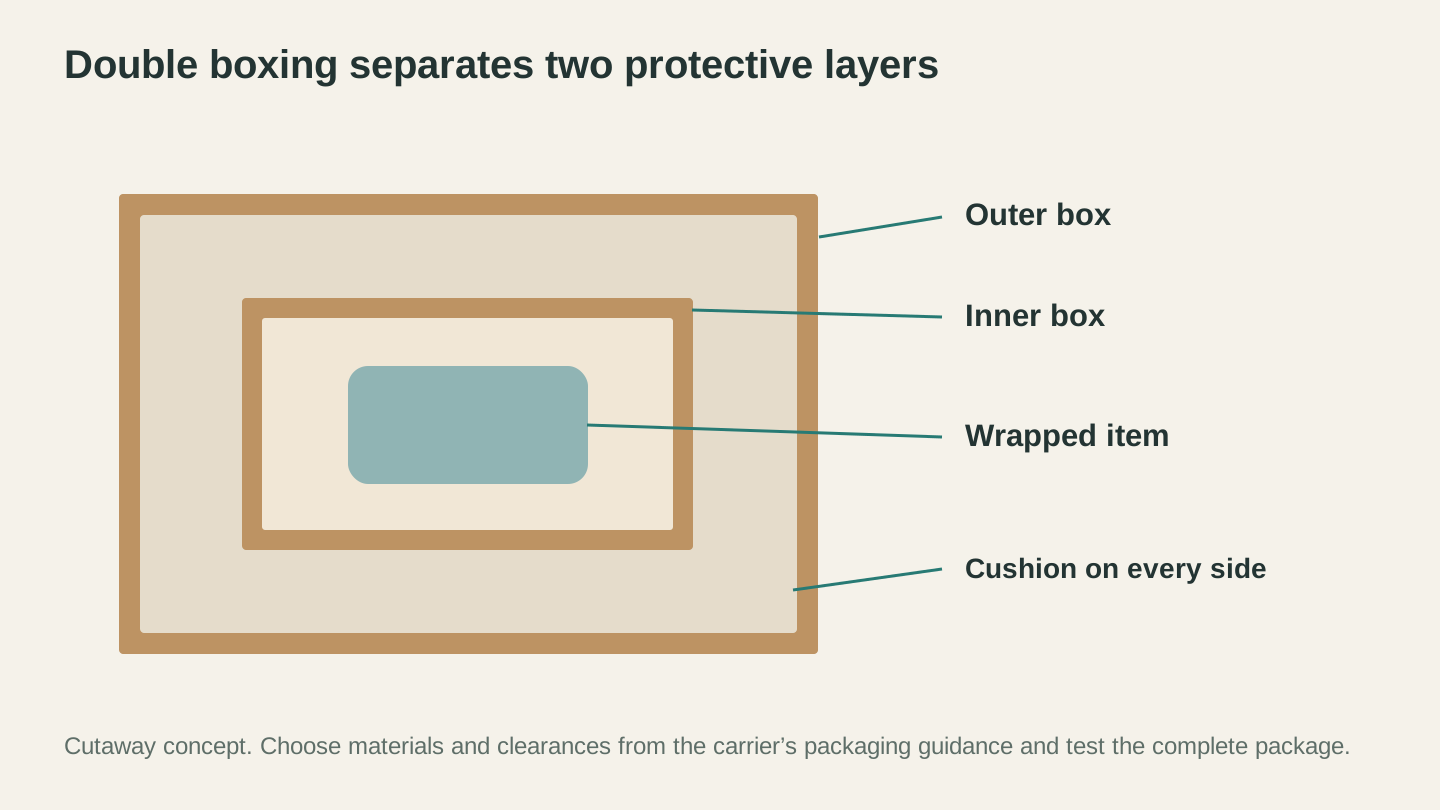
Conceptual double-box section showing separate cushioning around the item and around the inner box. Choose materials and spacing for the product and carrier requirements.
Box Size and Dimensional Weight
Here is the concept that surprises most makers the first time it bites: carriers do not only charge by weight. Depending on the carrier and service, they can bill by dimensional weight, a billable weight calculated from the box's volume. A big box of nearly nothing still costs real money to ship, because it takes up truck space that could have carried something heavier.
The mechanics: length times width times height, divided by a carrier-specific divisor, gives a theoretical weight. You are charged on whichever is greater, the actual weight or that calculated one. The divisors and the services it applies to vary by carrier and change over time, so do not memorize numbers. Just remember the rule: volume costs money even when it weighs nothing.
What that means in practice:
- Size the box to the product, not the product to the box you have. Two extra inches of air on every side can push a light package into a higher billable weight.
- Measure and weigh the actual packed box, then price it in your carrier's online calculator before you ever list the product. Do this at design time, not at order time.
- Consider shipping when designing the product. A sign that ships flat in a rigid mailer can cost dramatically less to send than the same design with a stand glued on. Sometimes "some assembly required" is a shipping strategy.
- Watch flat-rate options for dense items. Carrier flat-rate boxes can be a win for small heavy things and a loss for big light ones. The calculator settles it either way.
Warning
Never quote shipping from the bathroom scale weight of the bare product. The box, cushioning, and dimensional rules can move the real cost well above that estimate, and you eat the difference on every order.
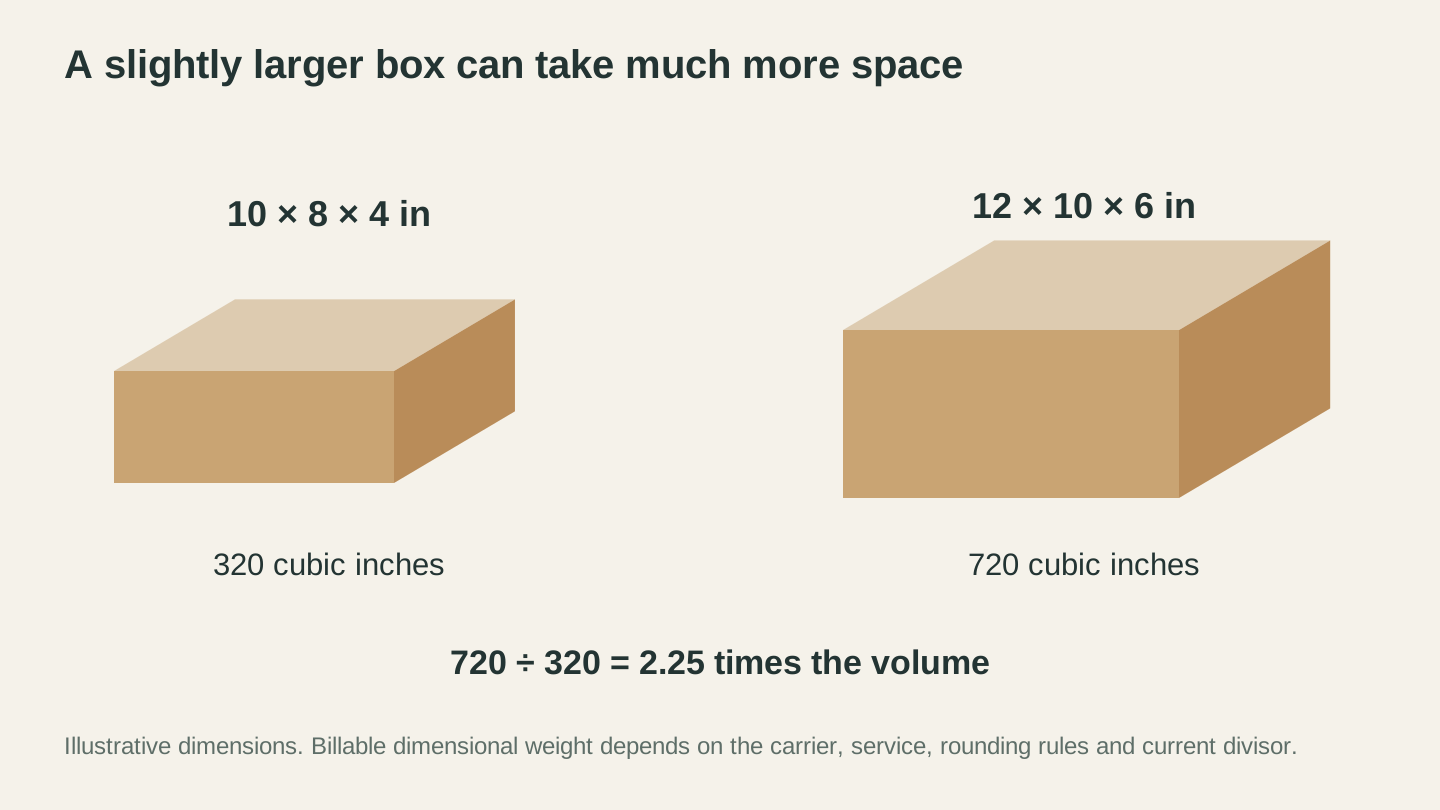
A small increase in each dimension can more than double box volume. These example dimensions show the arithmetic; carrier billing rules and actual packed weight still need checking.
Build It Into the Price, or Charge It Separately?
Both approaches work. Losing money happens when you pick neither and just hope.
Charging shipping separately is honest and simple: the buyer pays what it costs. The downsides are conversion and comparison. A surprise shipping cost at checkout is one of the most common reasons carts get abandoned, and marketplace search results often let shoppers favor free-shipping listings.
Building shipping into the price means raising the item price by your average shipping cost and advertising free shipping. Buyers consistently respond to it, which is why the tactic is everywhere. But the word "average" is doing heavy lifting in that sentence, and it is where the math goes wrong.
The free-shipping math, step by step:
- Pull your last ten or twenty shipped orders and total the real cost per order: label, box, materials.
- Average it. That number goes on top of your existing price, the one that already paid you properly for the work.
- Check the edge cases. An average works when your orders cost similar amounts to ship. If most orders are cheap but cross-country ones cost triple, the average undercharges exactly your most expensive orders.
- Re-run this every few months. Carrier prices move, usually upward, and a baked-in number goes stale silently.
The failure mode to avoid is treating free shipping as a discount you quietly absorb. If the item price does not go up when the shipping charge goes away, you did not offer free shipping. You cut your price and called it marketing.
If you sell on marketplaces, shipping settings, processing times, and how free shipping affects search placement have their own wrinkles. Our Etsy guide for makers covers that side of it.
Picking a Carrier and Service
Specific rates belong in carrier calculators, not blog posts. The principles travel better than any number:
- Compare per package shape, not per carrier. Each carrier tends to win a different weight and size range. The right question is never "which carrier is best" but "which service is best for this box."
- Buy labels through a platform, not at the counter. Marketplaces and shipping platforms typically pass on commercial pricing that is meaningfully below walk-in retail rates. Paying counter price for a business shipment is a standing donation to the carrier.
- Match speed to the product. Most handmade goods do not need expedited service, and buyers of handmade items generally expect a short processing time anyway. Say your processing time clearly in the listing and ship ground-class services with tracking.
- Weigh and measure honestly. Carriers audit packages, and an underdeclared label can be billed back to you later at a corrected, higher price.
Tracking, Insurance, and the Damage-Claim Reality
Tracking is not optional. It is your essential evidence in any "it never arrived" dispute, and marketplace seller protections commonly require it as a condition of eligibility, with narrow documented exceptions like local pickup. Ship with a tracked service whenever one exists for your package.
Insurance is a threshold decision. Some services include limited coverage and some sell it as an add-on; check what your specific service actually includes rather than assuming. Then set a personal rule based on replacement cost, meaning your materials and time to make it again, not the retail price. Below your threshold, self-insure: accept that a rare loss costs you a remake. Above it, buy the coverage. A threshold you picked once beats a decision you agonize over per order.
The damage-claim reality, from the trenches: claims are paperwork, they take time, and they can be denied when the carrier judges the packing inadequate. Three habits make claims survivable:
- Photograph the packed box before sealing it for anything valuable. Proof of adequate packing is the whole argument.
- Tell the buyer to keep everything. Claims commonly require inspection of the damaged item and the packaging. A buyer who helpfully threw the box away can sink the claim.
- Make the customer whole first, claim second. Replace or refund promptly, then pursue the claim on your own timeline. The review the buyer leaves is worth more than the claim payout.
Info
Carrier liability is generally capped at the declared value, and third-party insurance pays out under its own policy terms. Neither reimburses the hours, the follow-up messages, or the review risk. The cheapest insurance you can buy is the sturdier box.
International Shipping, Honestly
International orders feel like free growth until the first one goes sideways. The honest version:
Customs forms are legal documents. You declare the contents and the actual value, and buyers will sometimes ask you to mark a purchase as a gift or undervalue it so they dodge import fees. Decline every time. A false declaration can bring customs penalties or a seized shipment, can complicate any later carrier or insurance claim depending on the policy terms, and it is your name on the form.
Know who pays the import charges before you promise anything. Duties, taxes, and brokerage fees are often collected from the recipient on arrival, and a surprised buyer becomes an angry review. But who is responsible depends on the destination, the shipping terms, and your marketplace's rules, some of which now require certain fees to be handled upfront. Check the rules for where you are shipping, then say plainly in your listing who pays what.
Expect slower and murkier. Cross-border tracking can thin out mid-journey, delivery estimates stretch, and lost-package disputes take longer to resolve.
It is fine to skip it. If international orders are rare for you, the paperwork, the risk, and the customer-service load can cost more than the sales are worth. Shipping only domestically is a legitimate business decision, not a failure. Plenty of makers do their growing at local markets and fairs instead, where the shipping cost is a table and a tank of gas. If you do go international, start with one or two countries you can genuinely service and expand from results.
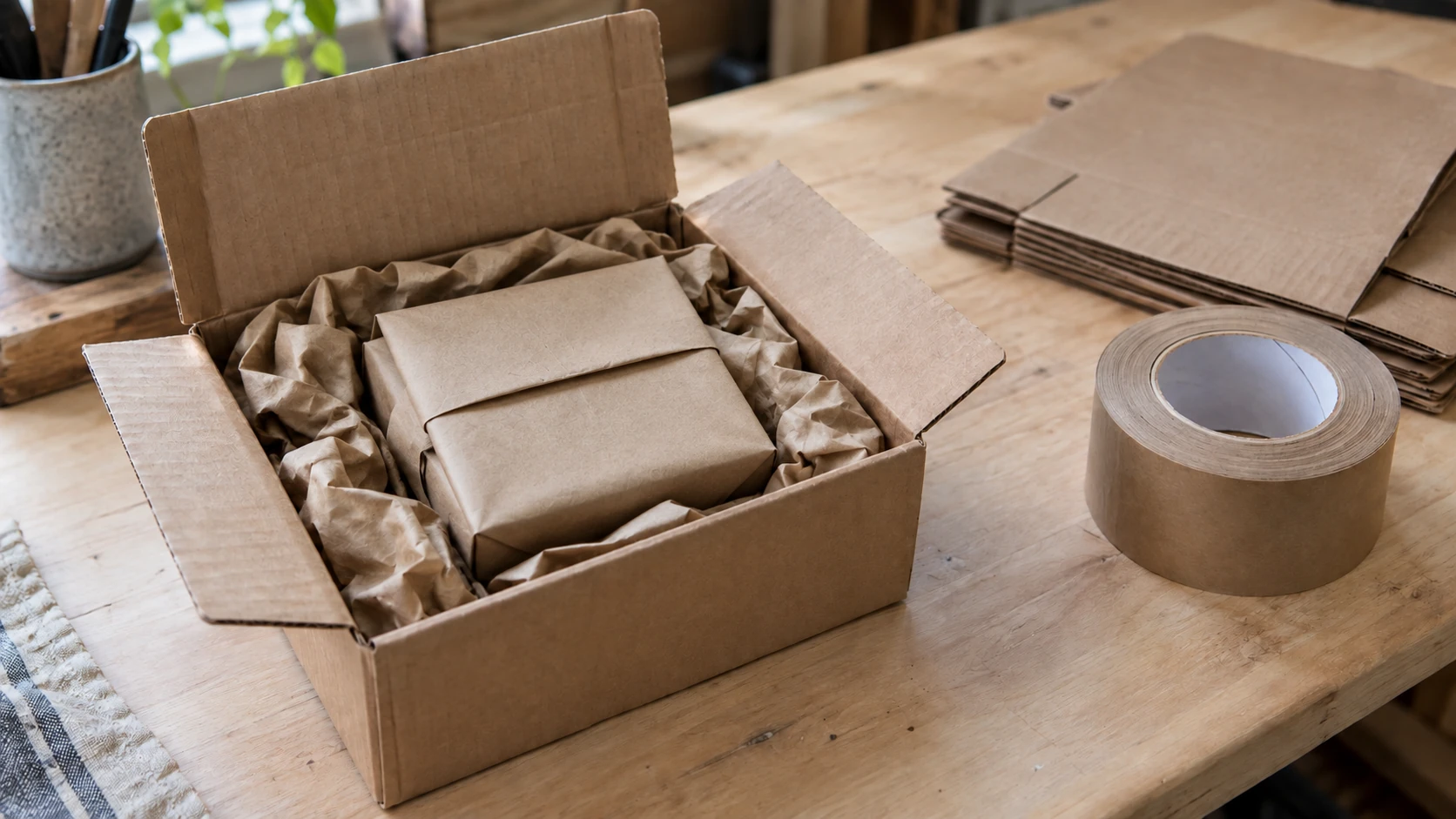
The same packing example after wrapping the stack. Check movement, cushioning and closure for the actual product; the photograph does not establish tested shipping protection.
An Unboxing That Doesn't Eat the Margin
Presentation sells repeat orders, and it can also quietly consume everything this post just saved. The trick is spending on impression per dollar, not on volume of stuff.
What earns its cost:
- Kraft paper and twine. Cheap, fast, and reads as handmade in the best way. A tissue-and-sticker pile often costs more and reads as generic.
- One small card. A thank-you with a care instruction or two. Print them in batches; the marginal cost is pennies and it is the thing buyers photograph.
- A clean, uncluttered box. Neat packing itself is presentation. A snugly packed, well-taped box says careful maker before anything else is opened.
What usually does not: branded custom boxes at small volume, multiple layers of ribbon and filler, and anything that adds enough bulk to change the shipping price. If the presentation upgrade pushes you into a bigger box, it has a shipping surcharge hiding inside it.
Then put the presentation to work: photograph your packaging once and mention it in the listing, because "arrives gift-ready" sells gifts. This is where ListingLab fits. Upload a product photo and it drafts titles, descriptions, and keywords, and that text generation runs on your plan's chatbot messages, not credits. Its AI product photos, including lifestyle and seasonal styles, cost 1 credit each when your only shot of the packed box was taken on the packing bench.
Ship the First One This Week
The whole system condenses to five moves:
- Cost one real packed order end to end, and put that number into your price.
- Standardize one packing recipe per fragility tier and buy the materials in bulk.
- Size boxes tight, then price the actual packed box in your carrier's calculator before listing.
- Ship everything tracked, insure above a threshold you set once, and photograph valuable packs.
- Keep the unboxing cheap and deliberate: kraft, twine, one card.
Shipping stops being a leak the day it becomes a line item you planned instead of a surprise you absorbed. And when the box is ready but the listing is not, ListingLab will write the titles, descriptions, and keywords from a single photo so the order that pays for all this packaging actually shows up.
Related Tools
Ready to try these tools?
Sign up free, no credit card required. Free tools available immediately.
Start Free