

What Does 3D Printing Actually Cost? The Honest Breakdown
Ask what 3D printing costs and you get two kinds of answers. The salesman's version: "prints cost pennies!" And the burned-out hobbyist's version: "the printer is the cheapest part, abandon hope." Both are half true, which makes them both useless when you are deciding whether to spend real money on a machine.
So here is the whole bill, in order: the printer, the plastic, the power, the parts that wear out, the prints that fail, and the upgrades you may or may not need. All the numbers below are example figures and typical ranges for planning, not quotes. Prices move, regions differ, and your electric rate is not my electric rate. The math is the point; plug in your own numbers.
Tip
Short answer: a typical hobby print costs a few dollars in material, though big prints can run more. Example: a 100 gram print from a $20 spool is about $2 in plastic plus a few cents of electricity. The real money is the printer itself, the consumables nobody mentions, and the failed prints you have not budgeted for yet.
The Printer: What More Money Actually Buys
Printer prices span roughly two orders of magnitude, and the confusing part is that a cheap machine and an expensive one make objects out of the same plastic. The tiers below are illustrative, not a shopping list. What changes as you spend more is not what you can print. It is how often printing works on the first try, and how much of your evening you spend making it work.
| Tier | Typical range | What you get | What you give up |
|---|---|---|---|
| Entry bedslinger | $150 to $300 | A real, capable printer | Often your time: more tinkering and slower speeds, though this varies a lot by model |
| Mid-range | $300 to $700 | Quality-of-life features like auto bed leveling and faster speeds | Not much, honestly. This tier is the sweet spot for most people |
| Enclosed / high-speed | roughly $700 to $1,500, with overlap | Speed, an enclosure for warp-prone materials, multi-color options | Money, and bigger footprint |
| Large format / pro | $1,500+ | Build volume, engineering materials, built for sustained output | A car payment |
The honest framing, as a rough rule with plenty of model-by-model exceptions: at the cheap end you tend to pay with time instead of money. That is a fine trade if tinkering is part of the fun for you, and a miserable one if you just want the object. At the expensive end, you are mostly buying speed, capacity, and the ability to print warp-prone materials, not better basic prints. The market moves fast, so check current models before treating any dollar threshold as gospel.
One more thing the spec sheets skip: budget for a starter kit of extras on day one. A few spools of filament, a scraper, some isopropyl alcohol, and a small tool kit add $50 to $100 in typical cases to whatever the printer costs.
If you are staring at three similar machines and cannot decide, Craft Chat is good at exactly this conversation: describe what you want to make, your space, and your patience level, and talk through which tier fits. It is free to use with your Craftgineer account, no credits required.
PRINT. CUT. CARVE.
- Multiple formats (SVG, DXF, PNG)
- Machine-tested designs
- Commercial licenses
Sponsored by PrintCutCarve.com
Filament: The Math Everyone Should Do Once
Filament is sold by the kilogram and consumed by the gram, and that gap is why prints feel almost free once you own the machine.
The formula is just: grams used x price per gram. Your slicer tells you the grams before you ever hit print.
Worked example with planning numbers: standard PLA commonly runs $15 to $25 per kilogram, so call it $20, which is $0.02 per gram.
| Typical weight | Material cost at $20/kg | |
|---|---|---|
| Phone stand | ~40 g | ~$0.80 |
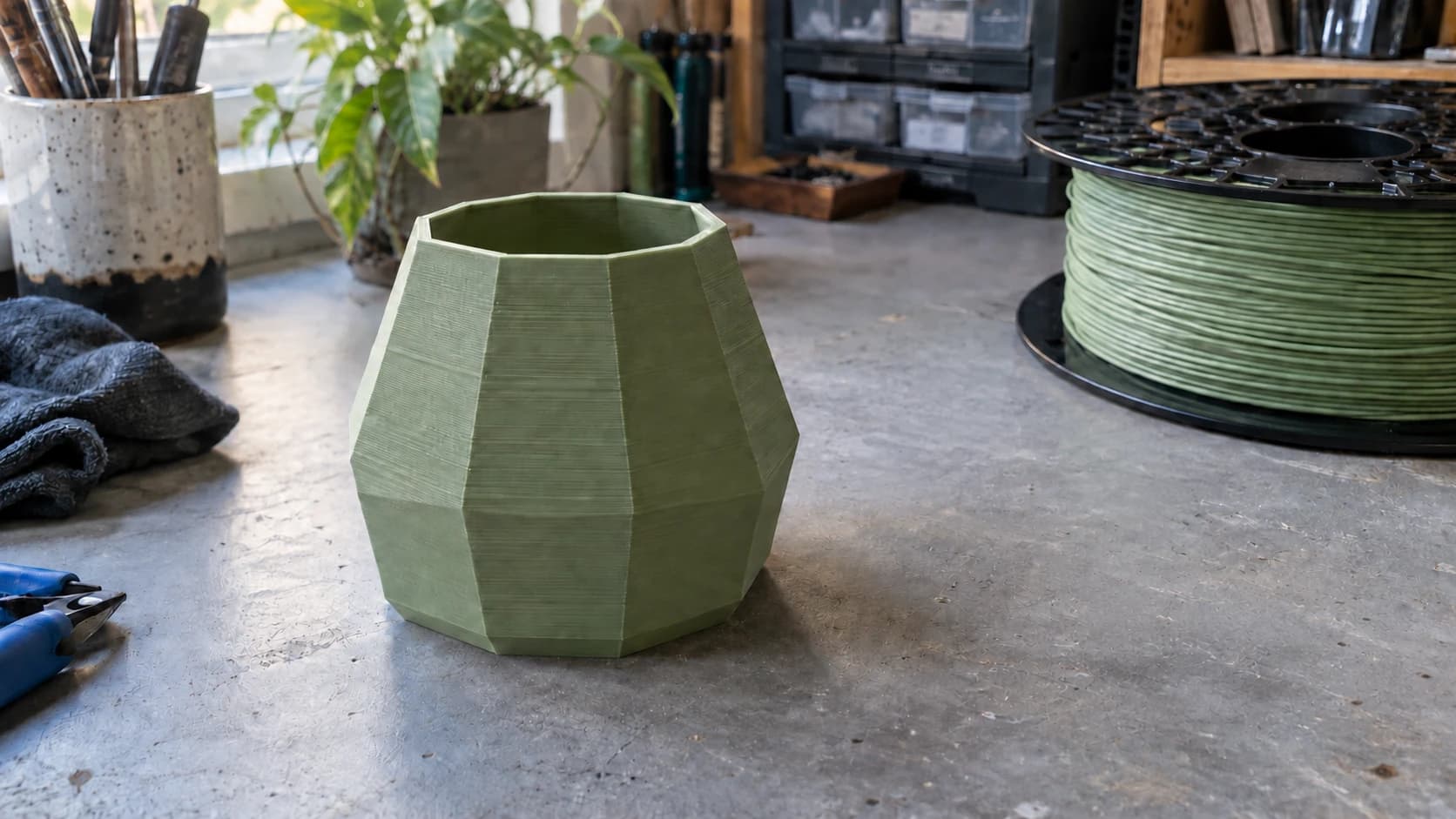
| Medium planter | ~100 g | ~$2.00 |
| Big articulated dragon | ~300 g | ~$6.00 |
| Full 1 kg spool, used to the end | 1,000 g | $20.00 |
Fancier materials multiply that. PETG and ABS usually sit near PLA. TPU and specialty blends often cost more, and engineering filaments like nylon or carbon-fiber blends can run $40 to $80+ per kilogram in typical listings, which turns that $2 planter into a $4 to $8 planter. Our filament guide covers which material earns its price for which job, because the answer is usually "PLA is fine" and occasionally very much not.
Info
A slicer's gram estimate includes supports and brims, and those go straight in the bin. A model that needs heavy supports can quietly cost far more plastic than the object you keep, and many slicers can show or help you compare the support share before you print. Orientation choices are money.
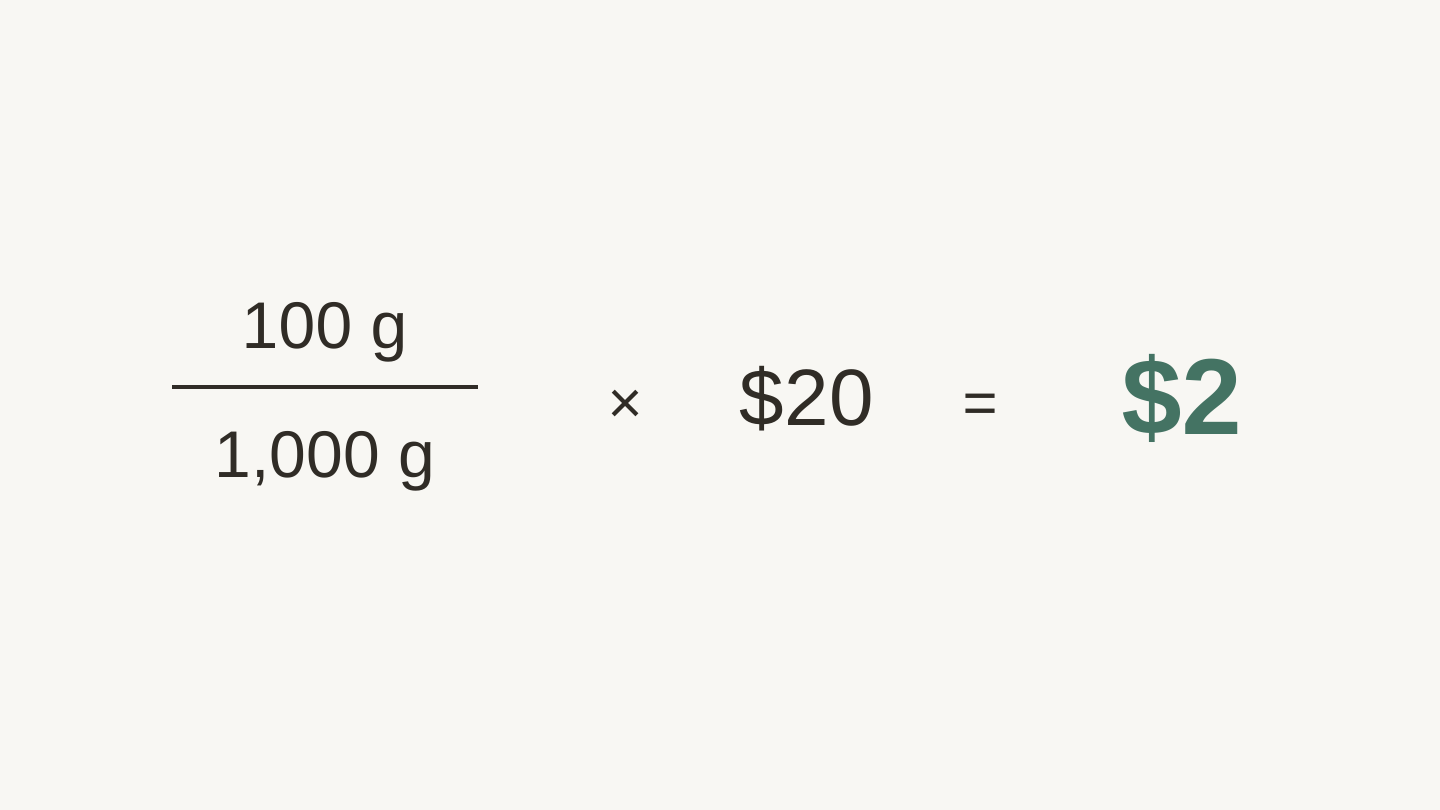
For this example, 100 ÷ 1,000 × $20 = $2 in filament. Add supports, failed attempts and the other costs in the article when estimating a finished part.
Electricity: Genuinely Cheap, Worth Knowing Anyway
This is the cost people fear most and should fear least. A typical compact hobby printer draws a lot briefly while heating, then settles down to something like 50 to 150 watts while printing, depending on the machine and bed temperature. Large-format and actively heated machines can draw more.
Example arithmetic: at an average draw of 100 watts and a rate of $0.15 per kilowatt hour, one print hour costs 0.1 kWh x $0.15 = 1.5 cents. A ten hour print is about 15 cents. Even a heated-chamber machine pulling several times that is well under a dollar for most prints.
Run your own numbers with your utility rate, but the conclusion rarely changes: electricity is a rounding error next to filament, and filament is a rounding error next to the printer.
The Consumables Nobody Puts in the Brochure
Here is where the "prints cost pennies" pitch quietly falls apart. A printer is a machine with wear parts, and the wear parts are your ongoing subscription fee.
- Nozzles. Brass nozzles wear, clog, and get wrecked by the occasional crash. A few dollars each in typical cases, and regular printing means replacing them now and then. Abrasive filaments (glow, carbon fiber) can wear brass fast and want a hardened nozzle instead.
- Build sheets. PEI sheets lose their grip eventually, get gouged by a scraper on a bad day, or claim a chunk of a stuck print. Expect to replace one every so often at roughly $10 to $40 depending on the printer.
- Lubricant. Moving axes want whatever maintenance your printer's manual actually specifies, often a periodic dab of grease or oil on particular parts. A tube lasts ages and costs little, but a neglected axis costs you print quality first and hardware second.
- The small stuff. Glue stick or adhesive for stubborn materials, isopropyl alcohol for cleaning the plate, spare PTFE tube, and eventually belts. Individually trivial, collectively real.
As a budgeting allowance, not a measured average, $50 to $100 per year in consumables is a reasonable figure for a hobbyist printing regularly. Not scary. Just not zero, and worth having in the mental ledger before the first clogged nozzle feels like a betrayal.
The Failure Allowance
Some prints fail. The spaghetti nest at 2 a.m., the first layer that never stuck, the support structure that fused to the part. This is normal, it happens to everyone, and it means some percentage of your filament budget buys objects that go directly into the bin.
For planning, pad your material cost by 10 to 20 percent as a failure allowance. That is a budgeting rule of thumb, not a measured law: your real rate depends on the machine, the materials, and how adventurous your prints are. A well-tuned machine printing proven models sits at the low end; ambitious prints on a temperamental setup can blow past the top of it.
If you are selling prints rather than just making them, this number stops being a footnote and becomes a line item in your pricing. Our guide to making money with a 3D printer gets into why underpricing failures is one of the classic ways print businesses lose money without noticing.
Optional Costs: The Upgrade Rabbit Hole
None of these are required to start. All of them are things you may genuinely want later, so budget-honest people should know they exist:
- Filament dryer ($30 to $80 typical for single-spool models; multi-spool units cost more): moisture ruins print quality for hygroscopic materials like nylon and TPU, and can degrade PETG too. In a humid climate this stops being optional fast.
- Enclosure ($50 to a few hundred): commonly required by filament makers for warp-prone materials like ABS, nice for temperature stability and keeping dust off.
- Hardened nozzle or upgraded hotend ($15 to $100): the ticket to abrasive and high-temperature filaments.
- Spare parts stash: a spare thermistor, heater cartridge, and nozzles mean a Tuesday failure does not become a two-week wait.
- Dry storage: boxes and desiccant for your growing spool collection, because the collection will grow. It always grows.
The trap here is not any single purchase. It is that upgrading becomes its own hobby. There are people with $400 printers wearing $600 of upgrades, and if that is fun for them, great. Just know which hobby you are budgeting for.
Print It or Buy It: The Honest Break-Even
Now the question the whole post has been building toward: does owning a printer save money?
Sometimes. Here is the honest version of when.
Where printing wins clearly:
- Replacement parts. The discontinued appliance knob, the broken drawer bracket, the missing game piece. These cost cents in plastic and would cost dollars plus shipping plus a week of waiting, if a replacement exists at all. This category alone quietly pays for printers.
- Custom anything. An organizer sized to your exact drawer, a mount for your exact camera on your exact shelf. Custom manufacturing normally costs a fortune; your printer does not care that the run size is one.
- Prototypes and iteration. Ten versions of an idea for a few dollars total. There is no store-bought alternative to compare against.
Where buying usually wins:
- Mass-produced commodity goods. A basic storage bin from a discount store costs a couple of dollars, arrives injection molded and stronger than anything your nozzle will lay down, and required zero hours of your printer's time. Printing it is possible and pointless.
- Anything where your time counts. A ten hour print to save three dollars is not saving, it is a hobby. Which is fine! Hobbies are allowed to cost money. Just do not call it thrift.
The break-even question is really a portfolio question. A printer that fixes a few household things a year, produces some genuinely custom objects, and provides entertainment along the way earns its keep easily. A printer bought to "save money" on things a store already sells cheaply will disappoint, gather dust, and end up on the used market at a steep discount. Which, incidentally, is a great place to buy your first printer.
A Realistic First-Year Budget
Pulling it together, example planning numbers for a typical hobbyist starting from zero with a mid-range machine:
| Item | Example range |
|---|---|
| Printer (mid-range) | $300 to $700 |
| Starter tools and extras | $50 to $100 |
| Filament (6 to 12 spools) | $120 to $250 |
| Consumables | $50 to $100 |
| Electricity | $10 to $30 |
| First year total | ~$530 to $1,180 |
After year one the printer is paid for, and the running cost drops to filament, consumables, and pocket change of electricity: a few hundred dollars a year for a heavily used machine, much less for a casual one. Per object, most prints really do cost single-digit dollars. The salesman was not lying about that part. He just started the story on page two.
Frequently Asked Questions
Is 3D printing an expensive hobby?
By hobby standards, no. After the printer purchase, typical running costs are a few hundred dollars a year for regular use, and each print is usually a few dollars of material. Compare that to what woodworkers spend on lumber or photographers spend on lenses and it holds up well.
How much does it cost to run a 3D printer per hour?
Electricity is the main directly metered per-hour cost, and at typical draws and rates it works out to a few cents per hour (example: 100 W at $0.15/kWh is about 1.5 cents). Material, wear, and the printer itself belong in the total cost, but they scale with what you print rather than with the clock.
Does 3D printing save money?
For replacement parts, repairs, and custom items: yes, often dramatically. For mass-produced goods a store sells cheaply: almost never. Owners who come out ahead are the ones printing things they could not otherwise buy.
Run Your Own Numbers
The arithmetic in this post is deliberately simple: grams times price, watts times rate, plus a failure allowance and a consumables line. What is not simple is matching a printer and materials to what you actually want to make, because that decides whether the machine earns its keep or gathers dust.
That conversation is exactly what Craft Chat is for. Tell it what you want to print, your budget, and your tolerance for tinkering, and work out which tier and which filaments fit before you spend anything. It is free with your Craftgineer account, no credits required. And if you are brand new to all of this, start with our 3D printing beginner's guide, then come back and put real numbers in the tables.
Ready to try these tools?
Sign up free, no credit card required. Free tools available immediately.
Start Free